
Charles Garnier: The Architect of Opera Garnier (Life, Career & Legacy)
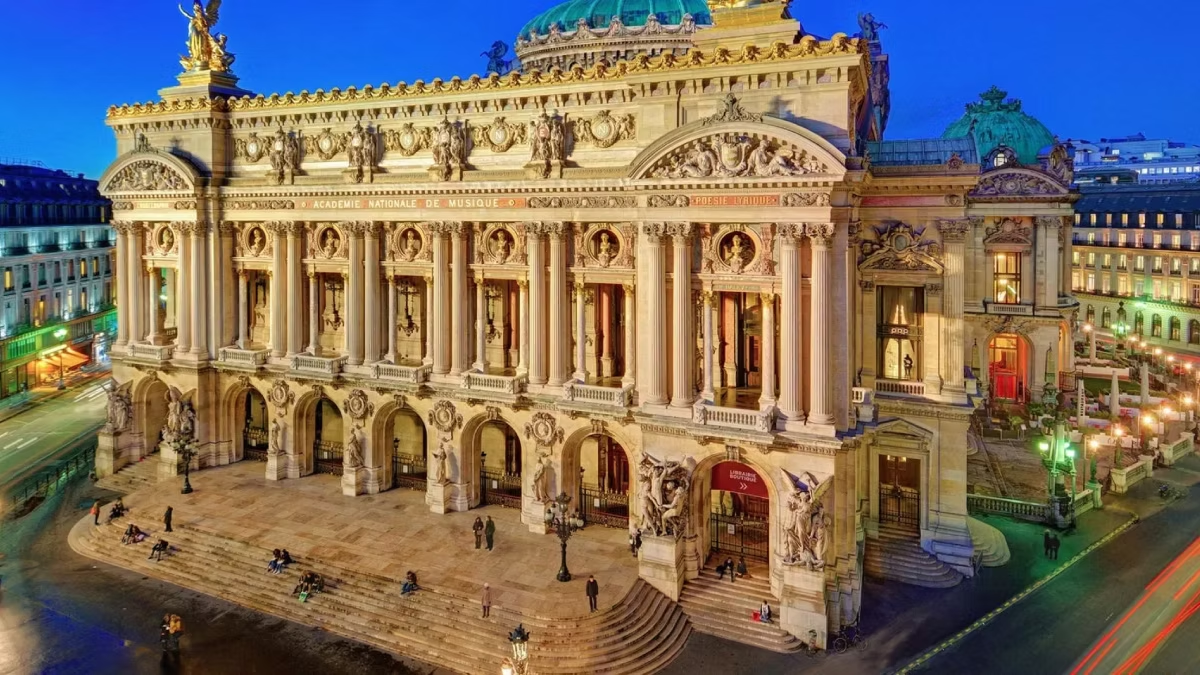
Charles Garnier (1825–1898) was a French architect who won the competition to design the Paris opera house in 1861 at the age of 35, having never completed a major building. He designed Opera Garnier over a 14-year construction period, maintaining personal supervision over every detail of the building from marble selection to fresco commissions. The result is the defining work of Beaux-Arts eclecticism and one of the most influential 19th-century buildings in the world. Garnier later designed the Monte Carlo Casino (1878) and the Cercle de la Librairie (1879), but never surpassed the scale and ambition of the opera house.
Charles Garnier is the kind of architect whose career was defined by a single building — and whose single building was so substantial that it would have been enough for any three careers. He won the Opera Garnier competition against 170 competitors in 1861, spent 14 years overseeing its construction with extraordinary personal commitment, and produced a building that generated a new architectural vocabulary absorbed by public buildings across Europe, the Americas, and beyond.
He then lived another 23 years in the shadow of his masterpiece, producing significant but smaller works, and died in 1898 having outlived the regime that commissioned his greatest work by nearly three decades.
Early Life and Training (1825–1854)
Charles Garnier was born on 6 November 1825 in Paris, the son of a wheelwright. He studied at the École des Beaux-Arts in Paris and won the Prix de Rome in 1848 — the most prestigious prize in French architecture, which funded five years of study at the French Academy in Rome and travel through Greece and the Ottoman Empire. This extended period of direct engagement with classical and Renaissance architecture gave Garnier an unusually comprehensive visual vocabulary and an empirical understanding of how historical styles functioned spatially — knowledge that would prove decisive in the Opera Garnier competition.
Garnier’s background was modest. His father worked in a carriage workshop; his mother was a laundress. He won entry to the École des Beaux-Arts against social odds and proved himself academically exceptional, winning the Prix de Rome on his fourth attempt. The Rome fellowship (1848–1854) was transformative — Garnier studied Roman antiquities, Renaissance churches, and Baroque palaces with the same systematic intensity he would later bring to the opera house competition.
He returned from Rome in 1854 with an extensive portfolio of measured drawings and a body of knowledge about historical architecture that few contemporary French architects matched. He had completed no significant buildings. He was 29 years old.
The Competition Victory (1860–1861)
The competition for the new Paris opera house was announced in December 1860. Garnier entered alongside the most established architects in France — men who had completed major public buildings, who had government commissions, who were members of the Institut de France. His submission was by any measure the least expected to win.
It won for reasons that his jury documented carefully. Where most entrants had designed a beautiful facade and a competent auditorium, Garnier had designed a complete building: a circulation system of extraordinary sophistication that separated every category of visitor, a section that demonstrated total understanding of the relationship between the public rooms and the stage machinery, and a compositional approach — the Beaux-Arts eclecticism he would call “Napoleon III style” — that was more original and more confident than any competing design.
The jury included the most eminent architects and cultural figures in France. Their decision was not unanimous, but it was decisive.
The Fourteen Years of Construction (1861–1875)
The construction of Opera Garnier was the defining professional experience of Garnier’s life. He was involved in every decision — from the geological crisis of the groundwater lake to the selection of individual marble quarries, from the management of the fresco commission to the acoustic testing of the auditorium.
He was not always easy to work with. His standards were absolute and his budget management was poor — he spent considerably more than the original estimate, partly through the genuine complications of the project (the groundwater, the war interruptions) and partly through his refusal to compromise on materials and craft. He argued with ministers, with contractors, with critics, and occasionally with the emperor who had commissioned the building.
What he produced through 14 years of this sustained effort is one of the most meticulously designed buildings of the 19th century. Every detail was intentional. The seven marble varieties in the staircase, the specific sculptors assigned to specific parts of the decorative programme, the relationship between the auditorium acoustic and the horseshoe form — nothing in the building is accidental.
Garnier’s Architectural Philosophy
Garnier articulated his architectural philosophy most clearly in his book Le Théâtre (1871), written during the Franco-Prussian War while construction was suspended. His argument was that architecture must serve its social function — that a theatre must facilitate not only the performance on stage but the performance of the audience, which is equally important to the theatrical experience.
This social understanding of architecture explains everything about Opera Garnier that seems excessive to modern eyes. The Grand Staircase is wide because width allows display. The Grand Foyer is long and mirrored because length and reflection create the maximum promenading experience. The building has multiple entrance routes of different grandeur because different categories of visitor require different ceremonial approaches. Nothing is gratuitous in Garnier’s building — everything serves the social function he understood with unusual clarity.
His eclecticism — the mixing of Baroque, Renaissance, and classical references in the building’s exterior — was also philosophical rather than merely stylistic. Garnier believed that no single historical style was adequate for a modern building serving a complex modern programme. The correct response to that complexity was to draw on the full historical vocabulary available to a trained architect, selecting elements for their aptness rather than their historical purity. This position — later codified as Beaux-Arts eclecticism — was enormously influential.
Later Career and Legacy
After Opera Garnier opened in 1875, Garnier continued to practice for another two decades but never again achieved the scale or public recognition of his masterpiece.
His most significant later work is the Casino de Monte-Carlo (1878, Monaco) — a building that successfully applies the Opera Garnier vocabulary at smaller scale in a different programme. The Monte Carlo Casino, like the opera house, is still operating in substantially its original condition.
He also completed the Villa Garnier in Bordighera, Italy (1872) — a personal project that shows his domestic architectural thinking — and the Observatoire de Nice (1888), which is less architecturally significant but demonstrates his continued professional range.
He published prolifically: Le Nouvel Opéra de Paris (two volumes, 1878–1881) is a complete architectural account of the opera house and remains an essential reference. L’Habitation humaine (1892, with Auguste Ammann) is a comparative study of domestic architecture across history and cultures.
Garnier died on 3 August 1898, aged 72. He was buried in the Montparnasse Cemetery. His portrait bust appears on the facade of Opera Garnier — a monument visible to every visitor who knows to look for it.
Finding Garnier in the Building
For visitors to Opera Garnier who want to engage with Garnier as a person rather than merely as an abstract designer, several things in the building invite that engagement:
His portrait bust: Garnier placed his own portrait among the decorative busts on the building’s exterior — a Baroque convention (self-commemoration in one’s own building) that he followed with characteristic directness. It is on the right side of the main facade; guides will point it out.
The Grand Staircase marble choice: Garnier personally negotiated the marble contracts for the staircase and is documented arguing with suppliers and ministry officials over specific quarry selections. When you look at the red Languedoc columns or the Algerian onyx balusters, you are looking at the result of specific arguments Garnier won.
The acoustic: Garnier tested the auditorium acoustic personally during construction. Contemporary accounts describe him singing in the half-completed room to assess whether the horseshoe form was working. The acoustic quality of the Opera Garnier auditorium — widely praised by musicians — is the result of an empirical process that Garnier directed personally.
Frequently Asked Questions
Who designed Opera Garnier?
Opera Garnier was designed by Charles Garnier (1825–1898), a French architect who won the open competition for the building’s design in 1861 at the age of 35. Garnier supervised every detail of the building’s 14-year construction and produced what is generally considered the defining work of Beaux-Arts architecture.
How old was Garnier when he won the opera competition?
Charles Garnier was 35 years old when he won the competition for the new Paris opera house in December 1860. He had completed no major buildings at the time of his win. The competition attracted 171 entries including submissions from France’s most established architects.
What other buildings did Garnier design?
Garnier’s most significant works beyond Opera Garnier are the Casino de Monte-Carlo in Monaco (1878) and the Villa Garnier in Bordighera, Italy (1872). He also completed the Observatoire de Nice (1888) and several smaller works. He published important architectural books including the two-volume Le Nouvel Opéra de Paris (1878–1881).
What architectural style did Garnier use for the opera house?
Garnier’s style is generally classified as Beaux-Arts eclecticism — a confident mixing of Baroque, Renaissance, and classical historical references selected for their functional and visual aptness rather than historical purity. When Empress Eugénie asked what style the building represented, Garnier replied: “It’s Napoleon III, Madame.” The style later became widely influential in public architecture across Europe and the Americas.
Is Charles Garnier commemorated at Opera Garnier?
Yes. Garnier’s portrait bust appears on the facade of Opera Garnier — a Baroque tradition of self-commemoration in one’s own building that Garnier followed deliberately. It is on the right side of the main facade. Guides on private tours will typically point it out.
