
Opera Garnier Auditorium & Chagall Ceiling: The Complete Guide (2026)
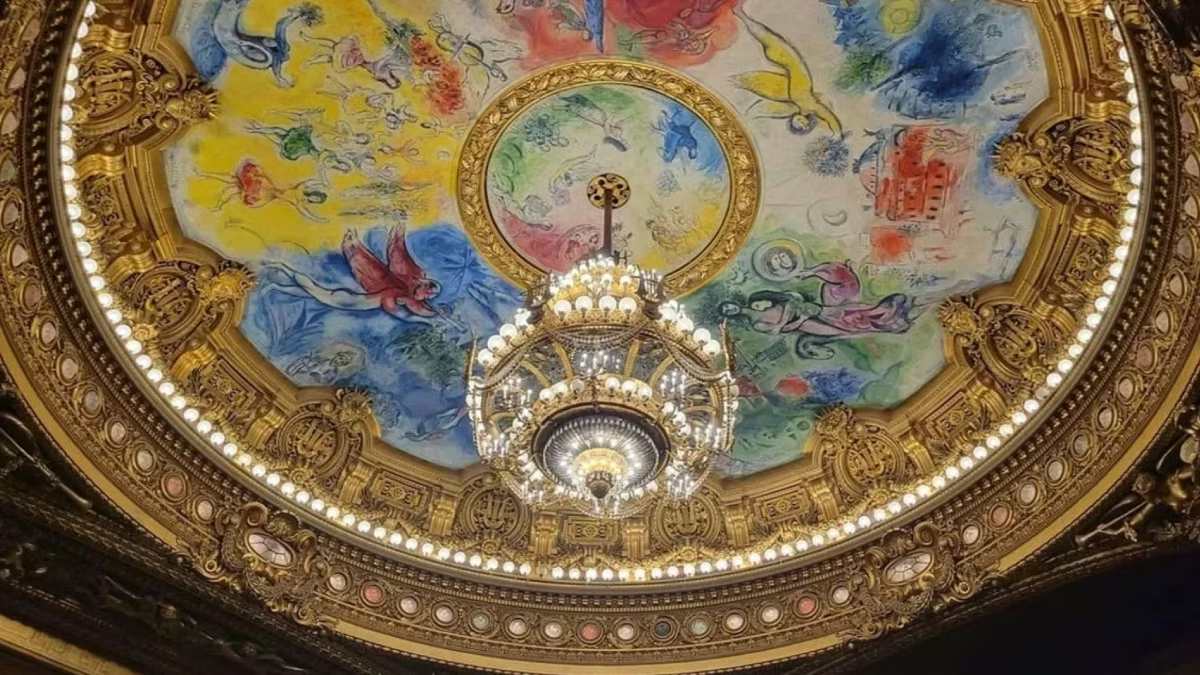
The Opera Garnier auditorium seats 1,979 people in a traditional horseshoe arrangement. Its ceiling was repainted by Marc Chagall in 1964 — a swirling composition of 14 operatic scenes in blues, greens, and golds, covering the original Baudry ceiling with a work that caused significant controversy at the time and is now considered one of Paris’s greatest works of public art. The six-tonne central chandelier is the one from the Phantom of the Opera. The auditorium is open to daytime visitors when no rehearsal is scheduled; book a morning slot for the best chance of access.
The auditorium of Opera Garnier is where the building’s two identities collide most dramatically. The room itself — horseshoe seating in four tiers, red velvet, gilded ironwork, candlelight-coloured chandeliers in the boxes — is pure Second Empire, perfectly of its 1875 moment. The ceiling is 1964: dreamlike, primary-coloured, unapologetically modern, a Chagall composition that has nothing to do with the 19th-century interior it inhabits and yet, somehow, has become inseparable from it.
The tension between the room and its ceiling is not incidental. It is the point.
The Auditorium: Architecture and Dimensions
The Opera Garnier auditorium seats 1,979 people in a traditional horseshoe configuration — four tiers of boxes and galleries rising from the orchestra stalls, with the stage at one end and the standing gallery (paradis) at the top. The room is approximately 32 metres wide, 32 metres deep, and 20 metres high from stalls floor to ceiling. Sight lines from the side boxes are partial — the room prioritises social visibility (seeing and being seen) over universal stage access. The acoustic is notably warm and rounded for a room of this size.
Garnier designed the auditorium’s proportions with reference to the Italian opera house tradition — the horseshoe shape that places the maximum number of boxes in close proximity to each other (the better for the social observation function) while keeping the stage visible from most positions. The shape is not acoustically optimal; it is socially optimal.
The four tiers rise from the orchestra stalls through three levels of boxes to the standing paradis (paradise) gallery at the top. The boxes on each tier are subdivided into individual compartments, each with a small anteroom behind, allowing private conversations and social manoeuvring between acts. The design is explicitly theatrical in its social architecture — the building accommodates, and facilitates, the performance of the audience.
The red velvet upholstery, the gilded ironwork balconies, the individual chandelier in each box — all of these maintain a consistent warm, firelit atmosphere throughout the room. The auditorium was designed for gas lighting (converted to electricity in the late 19th century) and the colour choices reflect that — everything looks best slightly amber.
The Chagall Ceiling
The Commission
In 1960, French cultural minister André Malraux commissioned Marc Chagall — then 73 years old, Russian-born, Jewish, a living modernist master — to repaint the ceiling of Opera Garnier’s auditorium. The existing ceiling painting by Paul Baudry (1874) was, Malraux felt, too conventional for the living monument he wanted Opera Garnier to be. He wanted a statement.
He got one. Chagall’s ceiling — completed in 1964 and unveiled to considerable controversy — covers 240 square metres with a composition organised around the central chandelier as a focal point, with 14 scenes from the operatic and ballet repertoire arranged in a swirling composition of colour and figure that owes as much to Russian folk art and French Fauvism as to any decorative tradition appropriate to a 19th-century opera house.
The controversy was immediate and significant. How dare a modernist painter cover a 19th-century masterwork? How dare a Jewish, Russian-born artist claim the principal room of French cultural life? The questions were both aesthetic and political. They are worth knowing about when you look up, because they give the ceiling a charge that pure appreciation misses.
The Fourteen Scenes
Chagall organised his composition into coloured segments radiating from the chandelier, each segment depicting scenes from the operas and ballets most associated with Opera Garnier’s history:
Blue segment: Works by Mussorgsky and Mozart — Boris Godunov, The Magic Flute. Blue-dominant, with the River Seine and the Paris roofline visible in the background. Chagall embedded Paris into the composition.
Green segment: Works by Berlioz, Wagner, and Rameau — The Damnation of Faust, Tristan und Isolde, Castor and Pollux.
White/yellow segment: Works by Tchaikovsky — Swan Lake, Sleeping Beauty, Romeo and Juliet. The most balletically oriented segment.
Red segment: Works by Stravinsky and Ravel — The Firebird, Daphnis and Chloé. The most compositionally energetic.
Orange segment: Works by Bizet and Verdi — Carmen, La Traviata, Aida.
Each segment includes floating figures, animals, and architectural fragments from the relevant operas — recognisable to those who know the works, beautiful as pure colour and form to those who don’t. Chagall’s great achievement with this ceiling is that it works on both levels simultaneously.
The Original Baudry Ceiling
Paul Baudry’s original 1874 ceiling was not destroyed by Chagall. It was covered — preserved beneath the Chagall composition. Baudry’s work depicted allegorical scenes in the French academic tradition, harmonious with the room’s overall decorative programme. Whether it should be reinstated at some future date is a debate that surfaces periodically in French cultural life.
The Chandelier
The central chandelier of Opera Garnier weighs approximately 6.3 tonnes. It is made of bronze and crystal and holds 340 light bulbs (replacing the original gas jets). It hangs on a mechanism that allows it to be raised for maintenance. In 1896, a counterweight for this mechanism fell into the audience during a performance, killing one person. This incident was reported in the contemporary press and was used by Gaston Leroux as the basis for the chandelier-crash scene in his 1910 novel Le Fantôme de l’Opéra. The chandelier in the novel and the subsequent Lloyd Webber musical is this chandelier.
The chandelier is both larger and more modest than visitors expect. It is large — six tonnes of bronze and crystal filling the full central void above the stalls — but the overall scale of the auditorium contains it. It does not dominate the room as photographs suggest; it centres it.
Looking at the chandelier knowing the 1896 story — the counterweight mechanism failure, the falling component, the single death that Leroux transformed into one of his most dramatic plot devices — adds a specific dimension to the experience. The Phantom’s chandelier crash is fiction. The incident that inspired it is fact. You are looking at the same fixture.
The chandelier is cleaned and maintained by raising it to ceiling level through the mechanism — the same mechanism whose counterweight failed in 1896. Conservation of a six-tonne crystal fixture in an actively used performance venue is, by any measure, a serious engineering undertaking.
The Phantom Connections
Box 5 — traditionally claimed by the Phantom in Leroux’s novel — is visible from the stalls. It is on the left (stage left, audience right) of the auditorium, in the first tier of boxes. There is no commemorative marker; it is simply Box 5, used as a regular performance box. Standing in the stalls and identifying it adds a dimension to the visit that feels appropriate to the building’s layered identity.
The underground lake, which the Phantom inhabits in the novel, is directly beneath the auditorium — below the stage, five levels down, accessible to no visitor but present nonetheless. The knowledge that there is a body of water directly beneath the stage enriches the mythology without requiring any visible evidence. See our underground lake article for the full real history.
When Is the Auditorium Open?
The auditorium closes when rehearsals are scheduled, which can happen any day of the week. This is the most frustrating reality of visiting Opera Garnier — the auditorium is the space most visitors most want to see, and it is the one least reliably accessible.
Strategies for maximising your chances:
- Book the 10:00 morning slot — rehearsals typically begin later in the morning
- Check the Paris Opera performance calendar the day before; if there’s an evening performance, there may be an afternoon rehearsal that closes the auditorium earlier
- Check the Paris Opera visiting calendar for confirmed open days
- July and August are paradoxically more reliable for auditorium access — the performance season winds down and rehearsal frequency decreases
See our opening hours guide for the full picture on how the rehearsal calendar affects access.
Photography Tips
The ceiling: Position yourself near the centre of the stalls, directly below the chandelier. Look directly upward. Use your phone’s native camera rather than a wide-angle lens — the full ceiling composition reads better from the standard field of view. No flash permitted.
The chandelier: Pull back towards the rear of the stalls to get the full mass of the chandelier in frame without cutting off its upper structure. Portrait orientation captures the relationship between the chandelier and the ceiling above it better than landscape.
The boxes: The tiered boxes, photographed from the stalls, convey the auditorium’s social architecture. The repeated arches of the balconies, the individual chandeliers in each box, and the colour consistency of the velvet give these shots strong compositional coherence.
Frequently Asked Questions
Who painted the ceiling of the Opera Garnier auditorium?
The current ceiling was painted by Marc Chagall in 1964, commissioned by French cultural minister André Malraux. It depicts 14 scenes from the operatic and ballet repertoire in a swirling composition organised around the central chandelier. The original 1874 ceiling by Paul Baudry is preserved beneath Chagall’s composition.
How heavy is the chandelier at Opera Garnier?
The central chandelier weighs approximately 6.3 tonnes. It is made of bronze and crystal and holds 340 light bulbs. It can be raised for cleaning and maintenance via the same counterweight mechanism whose failure in 1896 inspired the chandelier-crash scene in Gaston Leroux’s Le Fantôme de l’Opéra.
Is the Chagall ceiling at Opera Garnier original or a reproduction?
It is the original Chagall painting, completed in 1964. It is applied directly to the ceiling structure of the auditorium over the original Baudry ceiling. It has been conserved in situ and is the actual work Chagall painted, not a reproduction.
Can I see the auditorium on a daytime visit?
Yes, when no rehearsals are scheduled. The auditorium closes for rehearsals without fixed advance notice, but checking the Paris Opera performing schedule beforehand gives a good indication. Morning visits (10:00) are the most reliable for auditorium access. See our opening hours guide for full guidance.
What is Box 5 at Opera Garnier?
Box 5 is the opera box on the first tier, stage left (audience right), traditionally occupied by the Phantom in Gaston Leroux’s novel Le Fantôme de l’Opéra. In the novel, the Phantom claims Box 5 as his own and disrupts any performance in which management rents it to others. The box is identifiable from the stalls and remains a regular performance box today — no commemorative marker, but clearly visible.
