
Opera Garnier Rooftop Terrace: Views, Access & What to Expect (2026)
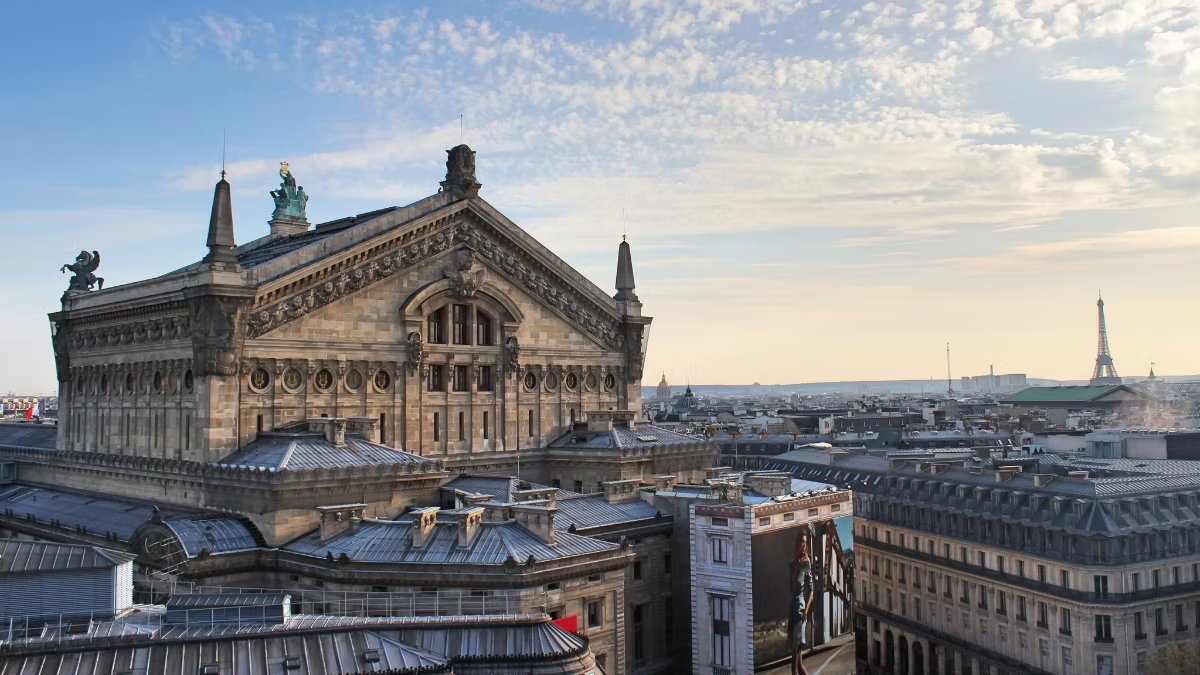
Opera Garnier has a loggia (exterior gallery) on the main visitor floor that provides views over Place de l’Opéra and along Boulevard des Capucines — this is accessible on standard tickets. A full rooftop terrace above this level, giving views of the sculpted roofline and the Apollo sculpture up close, is not consistently accessible to standard visitors. Access to the upper rooftop varies by date and availability; check the Paris Opera website. The Galeries Lafayette rooftop terrace (5 minutes away, free) offers the best elevated views of the Opera Garnier building from the outside.
The rooftop question at Opera Garnier is one of the most commonly misunderstood aspects of visiting. Visitors arrive expecting the kind of rooftop panorama offered by the Eiffel Tower or the Arc de Triomphe — a ticket buys you access to a designated observation level with 360-degree views. That is not what Opera Garnier provides as a standard visitor experience.
What Opera Garnier does provide: a loggia on the main visitor floor with external views along Place de l’Opéra; occasional access to upper exterior areas during special events; and the extraordinary experience of seeing the building’s sculptural roofline close-up — which is, architecturally, one of the most remarkable things in Paris — if you time your visit correctly or attend a Heritage Days event.
The Loggia: What’s Always Accessible
The loggia is the exterior-facing gallery running along the front of the building on the main visitor level — above the entrance but below the roofline. It overlooks Place de l’Opéra directly and offers views east along Boulevard des Capucines and west along Boulevard des Italiens.
From the loggia, you can see:
- The Place de l’Opéra and the traffic roundabout below
- The Café de la Paix and InterContinental hotel directly opposite
- The southern reach of Boulevard des Capucines
- The Avenue de l’Opéra stretching south towards the Louvre
- The top of the Galeries Lafayette dome to the east
The loggia is not a high viewpoint — you are essentially at second-floor level above Place de l’Opéra. It gives a sense of the building’s relationship to the surrounding urban fabric rather than a panoramic city view. As an architectural experience — standing on Opera Garnier’s exterior and looking out at Haussmann’s Paris as Garnier himself would have seen it — it is genuinely worthwhile.
The loggia is accessible on all standard entry tickets during standard visiting hours. It can be crowded in peak season as it is a natural photography location.
The Upper Rooftop and the Apollo Sculpture
Above the loggia, the building’s true roofline is a rich sculptural composition: gilded domes, allegorical figures, decorative chimneys, and at the apex, the Apollo sculpture holding aloft a golden lyre and a golden laurel wreath — the building’s highest point and the element that makes the Palais Garnier recognisable from across Paris.
The Opera Garnier rooftop is crowned by a gilded bronze sculpture of Apollo with a lyre and laurel wreath, flanked by allegorical figures of Poetry and Music. The Apollo group was created by Aimé Millet. On the building’s four corners, additional sculptural groups represent the arts of the theatre. The full rooftop sculptural programme is one of the most elaborate on any 19th-century public building in Europe and includes figures by several of France’s leading sculptors of the period.
Access to the upper terrace — close to the Apollo sculpture and along the full roofline — is not part of the standard visitor circuit. It is occasionally available during:
- European Heritage Days (Journées du Patrimoine): The third weekend of September typically brings extended building access including the upper rooftop. This is the most reliable opportunity to reach the rooftop level.
- Special events: The Paris Opera occasionally opens the rooftop for specific cultural events, concerts, or programming. These are announced with limited advance notice.
- Private event hire: The rooftop can be hired for private events — a category of access available to event organisers rather than individual visitors.
If seeing the Apollo sculpture and roofline close-up is a priority, check the Heritage Days programme for the current September — it is by far the most accessible opportunity.
Seeing the Rooftop From Outside: The Best External Views
Because the full upper rooftop is not consistently accessible from inside, the best views of Opera Garnier’s extraordinary roofline come from outside the building:
Galeries Lafayette rooftop terrace (free): The rooftop of Galeries Lafayette Haussmann — 5 minutes on foot east from Opera Garnier — offers an elevated view directly across at the Palais Garnier’s roofline and Apollo sculpture. You see the building from approximately the same height as the Apollo, from the east, giving a perspective on the full decorative programme that no ground-level view provides. This is the best available Opera Garnier rooftop view for standard visitors. See our after your visit guide for how to combine the two.
Place de l’Opéra: The main approach from the south end of Avenue de l’Opéra — standing at the junction with Boulevard des Capucines — gives the full facade elevation including the roofline. This is the canonical Opera Garnier view: the building framed by the Haussmann boulevard, the Apollo visible at the apex.
Rue Scribe (side elevation): The building’s side profile from Rue Scribe shows the relationship between the main volume and the stage house — revealing the building’s functional complexity behind its ceremonial facade.
Rue Auber (northeast angle): A slightly oblique view that captures the building in its urban context particularly well.
The Rooftop Sculptural Programme
For visitors who want to understand what they’re looking at on the roofline — from Place de l’Opéra, from the Galeries Lafayette terrace, or on the rare occasion when the terrace itself is accessible — the principal sculptural elements are:
The Apollo group (apex): Apollo with lyre and laurel wreath, by Aimé Millet. Gilded bronze. The highest point of the building.
Poetry and Music (flanking Apollo): Two female figures flanking the central Apollo group, also by Millet.
The four corner groups: Allegorical sculptures at the four corners of the main roofline represent the four principal arts of the performing stage. These were executed by different sculptors and show stylistic variation — collectively one of the most ambitious 19th-century public rooftop programmes in Paris.
Garnier’s portrait bust: Charles Garnier himself is commemorated on the building — his portrait appears among the decorative elements on the facade. Finding it is a small reward for close looking.
Frequently Asked Questions
Can you go on the roof of Opera Garnier?
The upper rooftop of Opera Garnier is not part of the standard visitor circuit and is not consistently accessible. The loggia (exterior gallery on the main visitor floor) is always accessible on standard tickets. The upper rooftop is sometimes open during European Heritage Days in September and for occasional special events. Check the Paris Opera website for current access.
Can you see Paris from Opera Garnier?
From the loggia (main visitor level), you have views over Place de l’Opéra and along the Haussmann boulevards. The view is at second-floor height — a sense of the immediate urban context rather than a panoramic cityscape. For elevated Paris views near Opera Garnier, the free Galeries Lafayette rooftop terrace (5 minutes on foot) is the better option.
What is on the roof of Opera Garnier?
The roof of Opera Garnier is an elaborate sculptural composition: a central gilded Apollo with lyre and laurel wreath at the apex, flanked by Poetry and Music figures, with four allegorical corner groups representing the performing arts. The full programme involved several leading French sculptors of the 1860s–1870s and is one of the most ambitious 19th-century rooftop sculptural ensembles in Europe.
What is the golden figure on top of Opera Garnier?
The golden figure at the apex of Opera Garnier is Apollo — god of music and the arts — holding a lyre in one hand and a laurel wreath in the other. The sculpture was created by Aimé Millet in gilded bronze. It is visible from across central Paris and makes the Palais Garnier identifiable on the skyline.
When can you access the Opera Garnier rooftop?
The upper rooftop is most reliably accessible during European Heritage Days (Journées du Patrimoine) in mid-September, when it typically forms part of the building’s extended special access programme. The loggia on the main visitor floor is accessible on all standard tickets throughout the year.
