
Opera Garnier FAQ 2026: Every Question Answered (Mega-Guide)
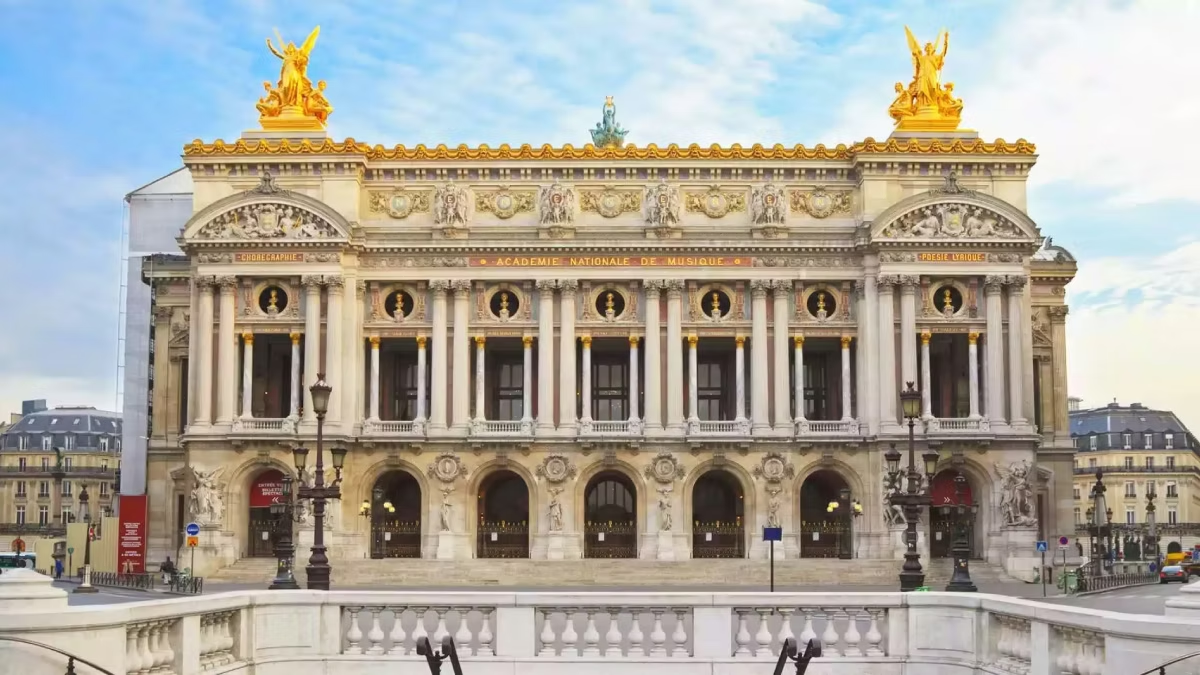
This is the complete FAQ for Opera Garnier (Palais Garnier) in Paris — covering tickets and prices, opening hours, getting there, what to see, guided tours, the Phantom of the Opera, accessibility, dress code, photography, and everything else visitors commonly ask before and during their visit. For detailed articles on any topic, follow the links throughout this page.
Essential Information
What is Opera Garnier?
Opera Garnier, officially the Palais Garnier, is a 19th-century Beaux-Arts opera house on Place de l’Opéra in Paris’s 9th arrondissement. Designed by Charles Garnier and completed in 1875, it was commissioned by Napoleon III as part of Haussmann’s transformation of Paris. Today it is both an active performance venue — primarily for the Paris Opera Ballet — and a public cultural monument open to daytime visitors. It is the real-world setting of Gaston Leroux’s 1910 novel Le Fantôme de l’Opéra and the building that inspired the Andrew Lloyd Webber musical.
Is Opera Garnier the same as the Paris Opera?
Opera Garnier is one of two venues operated by the Paris Opera (Opéra national de Paris). The other is the Opéra Bastille (opened 1989), which hosts most major opera productions. Opera Garnier is primarily the home of the Paris Opera Ballet. Both are managed as a single institution. See our Opera Garnier vs Opéra Bastille guide for a full comparison.
Is Opera Garnier worth visiting?
Yes — for the architecture, the history, and the Phantom mythology. It is one of the most spectacular 19th-century interiors in Europe. The visit works best when you arrive with some background knowledge of the building and its stories. See our honest is it worth visiting guide for a full appraisal.
What is Opera Garnier famous for?
Opera Garnier is famous for its extraordinary Beaux-Arts interior (Grand Staircase, Grand Foyer, Marc Chagall’s painted auditorium ceiling), its underground lake, its connection to The Phantom of the Opera, and its 150-year history as one of the world’s leading opera and ballet institutions.
Tickets and Prices
How much does it cost to visit Opera Garnier?
A standard adult self-guided entry ticket costs approximately €14. A self-guided tour with audio guide included costs approximately €16–€18. Private guided tours start from around €35–€50 per person with entry included. See our tickets overview for all options and current pricing.
Do I need to book Opera Garnier tickets in advance?
Yes — booking in advance is strongly recommended, particularly from April to October. Walk-up availability exists but is unreliable. Booking in advance secures your preferred time slot. See our how to buy tickets guide.
Is Opera Garnier free to visit?
Children under 12 enter free. EU residents under 26 enter free (ID required). Visitors with a recognised disability and one companion enter free. European Heritage Days (mid-September) typically offer free or reduced admission. The Paris Museum Pass covers standard entry. See our free and discounted entry guide.
Where can I buy Opera Garnier tickets?
The easiest options are the reserved entry ticket, Opera Garnier Private Guided Tour, and private guided tours. The official Paris Opera website sells performance tickets.
Does the Paris Museum Pass include Opera Garnier?
Yes. The Paris Museum Pass covers standard daytime entry to Opera Garnier. It does not include audio guide hire or guided tours. See our free and discounted entry guide for the full Museum Pass analysis.
Is there a skip-the-line ticket for Opera Garnier?
Pre-booking any ticket online effectively skips the box office queue for walk-up visitors (which runs 20–40 minutes in peak season). There is no separate premium skip-the-line product. See our skip the line guide for the honest explanation of how queuing works.
Opening Hours and Closures
What time does Opera Garnier open?
10:00 daily. See our opening hours guide.
What time does Opera Garnier close?
Standard closing is 16:30 (last entry 16:00). Extended summer hours (July–August) close at 17:00 (last entry 16:30). On evening performance days, the building may close to daytime visitors as early as 13:00.
Is Opera Garnier open every day?
On most days, yes — but not all. It closes on 1 January, 1 May, and for full-building events. Partial closures (auditorium only) happen when rehearsals are scheduled. Always check the Paris Opera calendar before visiting. See our opening hours guide.
Why is the Opera Garnier auditorium sometimes closed?
The auditorium closes when rehearsals are scheduled. This is the most common partial closure — the rest of the building remains open. For the best chance of auditorium access, book the 10:00 slot and check the performance calendar beforehand.
What is the best time to visit Opera Garnier?
10:00 on a weekday in September–November or February–March. The building is quietest, the light is best, and the auditorium is most likely to be open. See our best time to visit guide.
Getting There
What metro goes to Opera Garnier?
Opéra station (lines 3, 7, and 8) is directly in front of the building. Exit at “Place de l’Opéra” and the facade is immediately visible. The RER A at Auber station is a 2-minute walk with better accessibility. See our nearest metro guide.
How do I get from CDG to Opera Garnier?
Take the RER B to Châtelet–Les Halles, then RER A one stop to Auber (~50–60 minutes, ~€11.80). Or taxi (fixed rate ~€56–€62, 45–60 minutes). See our CDG arrival guide.
How do I get from Orly to Opera Garnier?
Metro Line 14 from Orly to central Paris then a connection, or Orlyval + RER B + RER A (~45–55 minutes, ~€15.50). Taxi fixed rate ~€35. See our Orly arrival guide.
Can I walk to Opera Garnier from the Louvre?
Yes — approximately 20 minutes south to north along Avenue de l’Opéra. The walk is one of the great Haussmannian urban approaches in Paris.
Is there parking near Opera Garnier?
The nearest car park is Indigo Opéra–Haussmann on Rue de la Chaussée d’Antin (5–7 minutes on foot, ~€4.50–€5.50/hour). Driving to Opera Garnier is not recommended for most visitors — the metro connection is excellent. See our parking guide.
What to See
What can you see inside Opera Garnier?
The standard visitor circuit includes the Grand Staircase, the loggia, the Grand Foyer, the auditorium and Chagall ceiling (when open), and the Bibliothèque-Musée de l’Opéra (library and museum). See our visitor guide for a full breakdown.
What is the Chagall ceiling at Opera Garnier?
Marc Chagall painted the Opera Garnier auditorium ceiling in 1964, commissioned by cultural minister André Malraux. The 240-square-metre composition depicts 14 scenes from the operatic and ballet repertoire in Chagall’s characteristic style of blues, greens, and golds. It covers the original 1874 Baudry ceiling, which is preserved beneath it. See our auditorium and Chagall ceiling article.
How long does a visit to Opera Garnier take?
1 to 1.5 hours for a self-guided visit without an audio guide. 1.5 to 2 hours with an audio guide. A private guided tour runs approximately 1.5 hours. See our how long to spend guide.
Can you go on the rooftop of Opera Garnier?
The loggia (main visitor level) overlooks Place de l’Opéra and is always accessible on standard tickets. The upper rooftop (near the Apollo sculpture) is not consistently accessible — it is sometimes open during European Heritage Days in September. See our rooftop guide.
The Phantom of the Opera
Is the underground lake at Opera Garnier real?
Yes. The underground lake is a real body of water beneath the building, created during construction in the 1860s. It is approximately 55 metres long, 3–4 metres deep, and five levels below the stage. It cannot be visited. See our underground lake article.
Is the Phantom of the Opera based on a real place?
Yes — on Opera Garnier specifically. Gaston Leroux researched the building exhaustively and used real architectural features as his setting (the lake, Box 5, the chandelier, the cellars). The Phantom himself is fictional. See our Phantom of the Opera article.
Where is Box 5 at Opera Garnier?
Box 5 is in the first tier of the auditorium, stage-left side (audience right). It is visible from the stalls when the auditorium is open. In Leroux’s novel, the Phantom claimed this box as his exclusive property.
Did the chandelier at Opera Garnier really fall?
A counterweight from the chandelier mechanism fell into the auditorium during a performance in 1896, killing one person. Leroux transformed this real incident into the chandelier-crash scene in his novel. The chandelier itself has never fallen.
Guided Tours and Audio Guide
Is it worth getting a guide at Opera Garnier?
For first-time visitors, yes — some form of interpreted content significantly improves the experience. The audio guide is the best value option; a private guided tour delivers superior depth for groups and families. See our self-guided vs guided comparison.
What languages is the audio guide available in?
French, English, German, Spanish, Italian, Portuguese, Japanese, Mandarin, and Korean, among others. See our audio guide article.
How much does a private guided tour cost?
Private guided tours at Opera Garnier cost approximately €35–€50 per person with entry included. The ballet show tour costs approximately €80–€120 per person. See our guided tours overview.
Practical Information
What is the dress code for Opera Garnier?
No formal dress code for daytime visits — smart casual is appropriate. For evening performances, the convention is smart to formal. See our what to wear guide.
Can I take photos inside Opera Garnier?
Yes. Personal photography is permitted throughout the main visitor areas. Flash, tripods, and selfie sticks are not allowed. See our photography rules guide.
Is Opera Garnier accessible for wheelchair users?
Partially — a lift provides access to the main visitor levels; the Grand Staircase is not wheelchair-accessible. Contact the accessibility team in advance ([email protected]). See our accessibility guide.
Is Opera Garnier suitable for children?
Yes, for children aged 8 and above, particularly those familiar with the Phantom story. Children under 12 enter free. See our visiting with kids guide.
Are there restaurants near Opera Garnier?
The Café de la Paix on Place de l’Opéra is the most famous (and expensive) option. Bouillon Chartier on Rue du Faubourg Montmartre (10 minutes on foot) is excellent value. See our restaurants nearby guide.
What hotels are near Opera Garnier?
The InterContinental Le Grand Hôtel is directly adjacent. The Hôtel Scribe is 2 minutes away. Mid-range options are on Boulevard Haussmann. See our hotels nearby guide.
What should I do after visiting Opera Garnier?
The Galeries Lafayette rooftop terrace (free, 5 minutes on foot), the covered passages of the 2nd arrondissement (10–15 minutes), and the Louvre via Avenue de l’Opéra (20 minutes on foot) are the strongest follow-on options. See our after your visit guide.
Combo Tickets
Can I combine Opera Garnier with other Paris attractions?
Three combo tickets are available: Opera Garnier + Musée d’Orsay, Opera Garnier + Seine River Cruise, and Opera Garnier + Arc de Triomphe. All are available to book online. See our tickets overview for booking links and itinerary advice.
Is the Musée d’Orsay near Opera Garnier?
The Musée d’Orsay is on the Left Bank, approximately 20–30 minutes from Opera Garnier by metro or 35 minutes on foot via the Tuileries. The two are natural thematic partners — both are Second Empire Beaux-Arts buildings, and the d’Orsay holds the world’s largest Degas ballet collection, directly connected to Opera Garnier. See our d’Orsay combo guide.
