
Is Opera Garnier Worth Visiting? An Honest Guide (2026)
Yes, Opera Garnier is worth visiting — but what you get depends on your expectations. For architecture lovers, the Grand Staircase, Grand Foyer, and Chagall ceiling are among the most extraordinary interiors in Europe, and at ~€14 the entry price is modest. If you’re hoping for an immersive performance experience or unlimited backstage access, a guided tour or evening performance will deliver more. The building is best experienced slowly, with some knowledge of the history before you arrive.
Paris is full of places competing for your time and attention. Opera Garnier is one of those that risks being bypassed — it doesn’t have the Eiffel Tower’s obvious drama or the Louvre’s encyclopaedic pull. And yet, I’ve rarely heard anyone say they regretted going. The building is simply extraordinary, and that’s worth understanding before you decide.
This is an honest guide to what the daytime visit delivers, who it genuinely suits, who might find it underwhelming, and what to do differently if the standard visit isn’t right for you.
What You Actually Get on a Daytime Visit
The standard daytime visit (~€14 for adults) gives you self-guided access to the public areas of the building. These are not secondary spaces — they include some of the most extraordinary rooms in Paris.
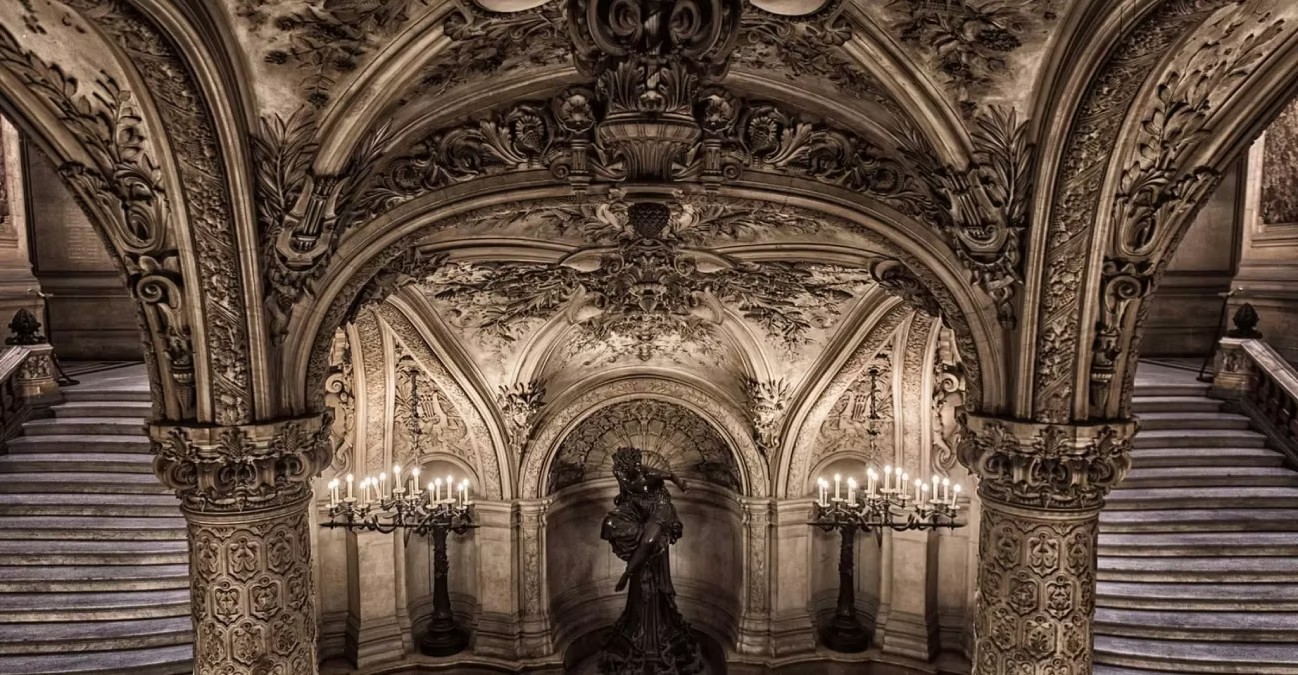
The Grand Staircase is the first moment of genuine awe. Double flights of white marble, soaring lanterns, a cascade of gilded stone — you walk into it and understand immediately why the building has been reproduced in paintings, films, and photographs for 150 years. Nothing prepares you for the scale of it.
The Grand Foyer runs the full width of the front facade and is often compared to Versailles. In terms of decoration and ambition, the comparison is fair. Gold leaf, painted vaulted ceilings, crystal chandeliers, and a long gallery of mirrors — it is relentless in a way that is somehow more delightful than overwhelming.
The Auditorium is what most people want to see most. The Marc Chagall ceiling — a swirling, dreamlike commission from 1964 — floats above the original red velvet and gilded horseshoe of boxes. This is not always accessible during daytime visits (morning rehearsals sometimes close it), but when you get in, it is the room that photographs least well and looks most extraordinary in person. The size, the detail, the acoustic silence of the empty space — it has a gravity that the photographs don’t convey.
The Opera Library and Museum is the most overlooked part of the visit. The Bibliothèque-Musée holds 600,000+ items — original set designs, period costumes, archival photographs, annotated scores — and it offers a genuine insight into the building’s history as a working theatre. Most visitors walk past it. Don’t.
The underground lake cannot be visited, but learning about it adds a dimension to the whole experience. It is real: a vast cistern beneath the building, originally dug to manage groundwater during construction. Gaston Leroux made it the lair of the Phantom, and Box 5 — said to be reserved for him — is visible from the auditorium.
A daytime visit to Opera Garnier costs approximately €14 for adults and gives self-guided access to the Grand Staircase, Grand Foyer, auditorium (subject to rehearsal schedules), opera library, and museum. The visit typically takes 1 to 1.5 hours. It is included with the Paris Museum Pass. For a richer experience with historical context and guaranteed access management, a guided tour (from around €25–40) is a better investment.
Who Will Love It
Architecture and design enthusiasts — This is one of the great 19th-century interiors in the world. Full stop. If you care about Beaux-Arts architecture, Second Empire Paris, or the history of operatic culture, you will find Opera Garnier endlessly rewarding.
Phantom of the Opera fans — The novel and musical are far better known than most people realise when they arrive. Box 5, the lake, the chandelier, the gothic undercurrent beneath the gilded excess — it is all there. Coming with this layer of story makes the visit much richer.
People who enjoy unhurried cultural visits — The building rewards slow looking. If you’re the kind of visitor who reads every caption and notices the detail in a carved cornice, you could spend two hours here and still feel there’s more to find.
First-time Paris visitors — Opera Garnier gives you an understanding of Second Empire Paris that the Louvre and Eiffel Tower don’t. It explains what Napoleon III was trying to build, why Haussmann rebuilt the city the way he did, and what cultural life looked like for Parisian high society in the 1870s. That context enriches everything else you see in the city.
Who Might Find It Underwhelming
Visitors expecting a performance atmosphere — The daytime visit is a museum experience, not a theatre one. The building is beautiful but quiet. If you want to feel the place alive — the orchestra, the audience, the curtain rising — you need an evening performance ticket or a guided tour that gives you more backstage context.
People on tight time budgets — If you have one full day in Paris and haven’t seen the Louvre, Musée d’Orsay, or the Eiffel Tower, Opera Garnier is probably not the first choice. It’s an hour to 90 minutes well spent, but it competes with heavy hitters. That said, the Musée d’Orsay is walkable from the opera, and a morning at Opera Garnier followed by an afternoon at the Orsay makes an excellent cultural day — see the Musée d’Orsay + Opera Garnier combo ticket for the combined option.
Young children under 10 — The building is impressive but there’s little for young children to engage with interactively. Older children (10+) who know the Phantom story often find it more interesting than adults expect, but for under-10s, the visit is probably too long.
Visitors who can’t get auditorium access — If the auditorium is closed due to a rehearsal and you’ve specifically come for the Chagall ceiling, the visit delivers less than expected. There’s no reliable way to guarantee access in advance. Visiting Monday–Wednesday in low season (November–February) maximises the probability.
Is a Guided Tour Worth the Extra Cost?
If the building is a priority for you and not just a checkbox, yes. A guided tour — especially a private one — changes the experience significantly. A knowledgeable guide can take you through the history of Charles Garnier winning the competition, Napoleon III’s architectural ambitions, the Phantom mythology, and the details of the Chagall ceiling that you’d otherwise walk past.
Private guided tours of Opera Garnier cost from around €25–40 per person for small groups and typically run 1.5–2 hours. The private guided tour is our recommended option for first-time visitors who want more than the self-guided experience delivers.
For the most immersive option — including access to behind-the-scenes areas and a meeting with a ballet artist — the private tour with ballet show is the premium choice.
The Verdict
Opera Garnier at ~€14 is one of the best value architectural experiences in Paris. The Grand Staircase alone justifies the entry price. The Grand Foyer and the auditorium (when accessible) add up to an interior that I’d argue is the most beautiful in the city — more consistently extraordinary than the Louvre’s public galleries, more coherent as a single design vision than Versailles.
The caveats are real: the auditorium isn’t always accessible, the daytime visit is a museum not a performance, and if you’re in and out in 45 minutes without pausing, you’ll wonder what the fuss was about. Slow down, bring some context about the building’s history, and it pays back generously.
Frequently Asked Questions
How does Opera Garnier compare to other Paris attractions?
It’s a different type of experience from the Louvre or Eiffel Tower — more intimate, more architecturally coherent, and less overwhelming in scale. As a single building interior, it’s arguably the most beautiful in Paris. It sits comfortably alongside Sainte-Chapelle and the Musée d’Orsay as one of the city’s great interior experiences.
Is Opera Garnier better than Opéra Bastille to visit?
For a daytime architectural visit, Opera Garnier is the clear choice. The Bastille is a modern building, functional and well-designed but not architecturally spectacular in the same way. Garnier is the one tourists come to see. If you want to attend a large-scale opera production, the Bastille’s technical capacity makes it the better performance venue — but that’s a different question. See Opera Garnier vs Opéra Bastille for the full comparison.
Can you just visit the outside of Opera Garnier for free?
Yes. The exterior — particularly the front facade on the Place de l’Opéra — is fully public and one of the great views in Paris. The rooftop sculpture of Apollo with his golden lyre is visible from the street. A walk around the exterior is worthwhile even if you don’t go inside, though the interior is where the building truly delivers.
Is it worth visiting Opera Garnier if I’ve already seen Versailles?
Yes, and the comparison is interesting rather than redundant. Opera Garnier and Versailles share an aesthetic tradition — Second Empire France drawing on the same vocabulary of gold, mirrors, painted ceilings, and marble — but they are different experiences. Versailles is a palace, grand in its exterior and gardens. Opera Garnier is a theatre, and its interiors are more concentrated in their magnificence.
