
The Phantom of the Opera — The Real Story Behind Opera Garnier (2026)
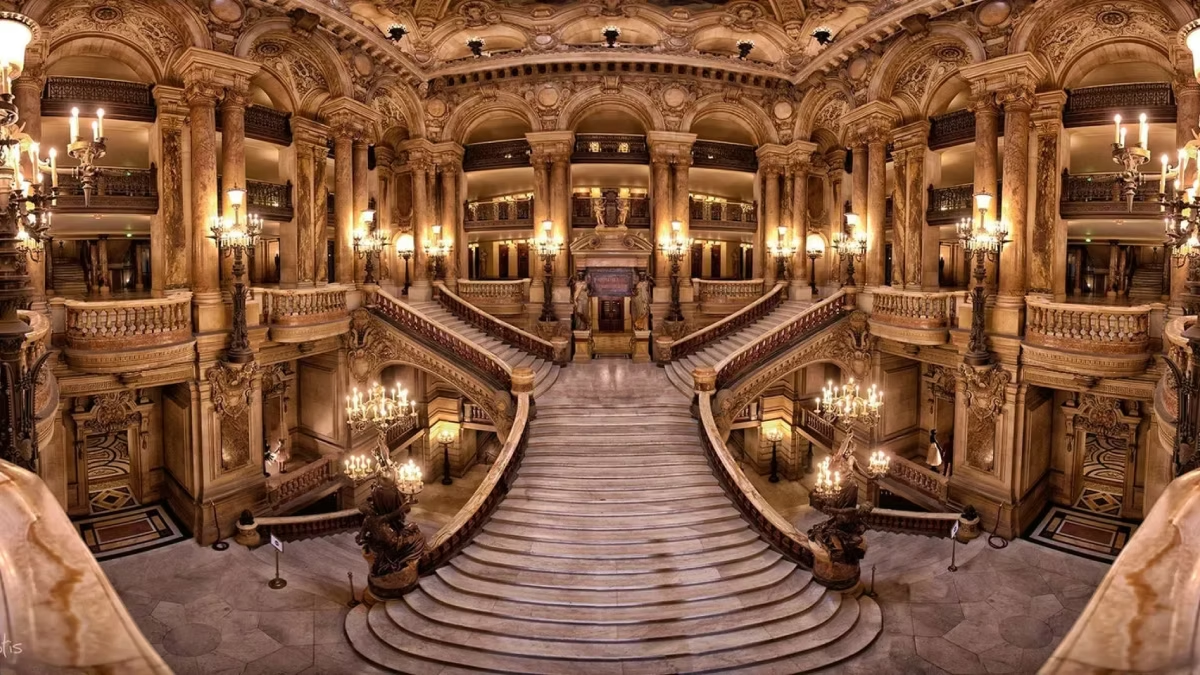
The Phantom of the Opera is based on a real building — Opera Garnier — but the Phantom himself (Erik) is fictional. Gaston Leroux’s 1910 novel uses real architectural features as its setting: the underground lake exists, Box 5 exists, the cellars run seven levels deep, the chandelier counterweight mechanism failed in 1896 causing one death, and the building is genuinely labyrinthine. What Leroux invented was the man who lived in it. The novel was adapted into the world’s longest-running musical by Andrew Lloyd Webber (1986), which has been seen by over 145 million people worldwide.
Standing in Opera Garnier and knowing the Phantom mythology changes the experience of every space. The chandelier hanging above the auditorium stalls — that specific chandelier, six tonnes of bronze and crystal — is the one whose counterweight fell in 1896. The lake is directly beneath you. Box 5 is to your left. The building extends seven levels downward into passages that no visitor has access to.
Gaston Leroux wrote a ghost story about this specific building. He was not making things up. He was observing carefully and then adding one carefully-placed fiction to what was already an extraordinary reality.
Gaston Leroux: The Journalist Who Wrote a Ghost Story
Gaston Leroux (1868–1927) was, before he was a novelist, one of France’s leading investigative journalists. He covered criminal trials, political scandals, and international events for Le Matin and other major Paris papers. He was specifically trained to observe physical detail, to gather testimony, and to construct a coherent narrative from fragmentary evidence.
When he came to write Le Fantôme de l’Opéra (serialised in Le Gaulois from September 1909, published as a book in 1910), he applied the same methodology to Opera Garnier. He obtained access to the building, spoke to staff and maintenance workers who knew the sub-basement levels, researched the building’s engineering history, and assembled a body of knowledge about the physical reality of the Palais Garnier that no purely imaginative writer would have had.
The result is a novel whose setting is accurate to a degree that continues to surprise researchers. The architectural details Leroux uses — the specific location of Box 5, the mechanism of the trap doors, the relationship between the cellars and the lake level, the precise form of the chandelier’s counterweight system — are correct. He was not imagining a generic opera house. He was describing this one.
What Is Real: The Architectural Evidence
The underground lake is real — a concrete-lined reservoir approximately 55 metres long, 3–4 metres deep, five levels beneath the stage, created during construction to retain groundwater. Box 5 is real — it exists in the first tier on the stage-left side of the auditorium. The chandelier is real — 6.3 tonnes of bronze and crystal. The 1896 counterweight accident is real — a mechanism failure killed one person in the audience. The building’s seven sub-basement levels and their labyrinthine passages are real. The fish in the underground lake are reportedly real. What Leroux invented was the man who lived there.
The Underground Lake
The lake beneath Opera Garnier was created during construction in the 1860s as a hydraulic stabiliser — see our underground lake article for the full engineering history. Leroux was aware of it from records and staff accounts. In the novel, Erik lives on an island in the middle of this lake, reached by a small boat through underground passages.
What Leroux added to reality: the island, the house, the pipe organ on the island, the gondola he uses to cross. What he used from reality: the lake’s existence, its darkness, its location beneath the building, the access passages through the cellars.
Box 5
In Leroux’s novel, the Phantom claims Box 5 as his exclusive property, disrupting any performance in which management rents it to others. Box 5 is a real box in the first tier of the Opera Garnier auditorium, on the stage-left side (the audience’s right). Contemporary accounts from the opera house in the 1880s and 1890s — the period Leroux was researching — include stories of a “ghost” associated with Box 5. Whether these stories preceded or were elaborated from Leroux’s research is unclear, but he was documenting a building already rich with its own mythology.
Box 5 remains in use as a regular performance box today. It has no commemorative marker, though guides will identify it from the stalls.
The Chandelier Incident of 1896
On 20 May 1896, during a performance of Meyerbeer’s Les Huguenots, a counterweight from the chandelier mechanism fell into the audience, killing a concierge named Mme Chomette who was seated in the stalls. The incident was reported in the Paris newspapers of the following day.
Leroux was a working journalist in the late 1890s and would certainly have been aware of the incident. In the novel, the Phantom brings down the chandelier deliberately during a performance — the incident’s fictional escalation from accident to murder weapon is exactly the kind of transformation a skilled journalist-novelist would make.
The Seven Sub-Basement Levels
Leroux describes a building of extraordinary underground depth — passages, chambers, and spaces below the stage extending downward through multiple levels. This is accurate. Opera Garnier has seven levels below the stage floor, making it one of the deepest building footprints in central Paris. The lower levels are genuinely labyrinthine: passages, equipment rooms, and infrastructure spaces that are difficult to navigate without prior knowledge.
Leroux’s Phantom knows these passages with perfect intimacy — he has lived in them for years. This knowledge gives the character his supernatural quality: he moves through the building without being seen because he knows routes that no one else uses.
What Is Fiction: The Phantom Himself
Everything specific to Erik — the Phantom — is fictional. There was no disfigured musical genius living in Opera Garnier’s cellars. There is no documented case of a person inhabiting the building’s lower levels during the period Leroux wrote about. The management of the Paris Opera in the 1890s did not report encounters with a phantom, beyond the generic “ghost” stories that circulate around any large, old, dark building.
Leroux’s genius was to place a fictional character in a real architectural setting with such specificity that the fiction and the reality become inseparable. Every visitor who has read the novel or seen the musical arrives at Opera Garnier already inhabiting a version of the story — and the building, which is genuinely extraordinary, does nothing to dispel it.
The Lloyd Webber Musical (1986)
Andrew Lloyd Webber’s musical adaptation of Leroux’s novel opened at Her Majesty’s Theatre in London on 9 October 1986 and ran continuously in the West End until March 2023 — 37 years, the longest run of any show in West End history. The Broadway production opened in January 1988 and ran until April 2023 — 35 years, the longest run in Broadway history. By 2023, the show had been seen by over 145 million people in 183 cities worldwide.
The musical’s global reach has made Opera Garnier recognisable to audiences who have never been to Paris and may not have read Leroux’s novel. The chandelier crashing, the underground lake, “The Music of the Night” sung from the Phantom’s lair — these images have a wider cultural currency than almost any other operatic or theatrical narrative.
For visitors to Opera Garnier who know the musical, the building provides a specific kind of satisfaction: the recognition that the imagery of the show derives from a real place, and that the place is significantly stranger and more compelling than even the musical suggested.
The Phantom Tour Experience
Several guided tour options at Opera Garnier specifically address the Phantom mythology:
The private guided tour allows a guide to deliver the Phantom connections at the exact relevant locations — Box 5 from the stalls, the chandelier narrative from beneath it, the lake from the areas closest to the sub-basement access. This is significantly more effective than reading about it beforehand.
The audio guide covers the Phantom connections through the auditorium narration — the chandelier, Box 5, and the lake — at the relevant spaces. It is a good option for independent visitors who want the connection made explicit.
Frequently Asked Questions
Is the Phantom of the Opera based on a real story?
The building is real. The key architectural features — the underground lake, Box 5, the chandelier, the seven sub-basement levels — are real. The 1896 counterweight accident that Leroux transformed into the chandelier crash is documented fact. The Phantom himself (Erik) is fictional. Gaston Leroux was a journalist who researched Opera Garnier extensively and placed a fictional character in a meticulously accurate real setting.
Is the underground lake from Phantom of the Opera real?
Yes. The underground lake beneath Opera Garnier is a real body of water created during construction in the 1860s. It is approximately 55 metres long, 3–4 metres deep, and located five levels below the stage. It cannot be visited. See our underground lake article for the full engineering and mythological history.
Where is Box 5 at Opera Garnier?
Box 5 is in the first tier of the auditorium, on the stage-left side (the audience’s right). It is identifiable from the stalls when the auditorium is open to visitors. In Leroux’s novel, the Phantom claims this box as his exclusive property. It remains a regular performance box with no commemorative marker.
Did the chandelier at Opera Garnier really fall?
A counterweight from the chandelier mechanism — not the chandelier itself — fell into the auditorium on 20 May 1896 during a performance, killing one person. This incident was reported in the contemporary Paris press and was used by Leroux as the basis for the chandelier-crash scene in his novel. The chandelier itself has never fallen.
When was The Phantom of the Opera written?
Gaston Leroux’s novel Le Fantôme de l’Opéra was serialised in Le Gaulois from September 1909 and published as a book in 1910. Andrew Lloyd Webber’s musical adaptation opened at Her Majesty’s Theatre in London on 9 October 1986 and ran until March 2023 — 37 years, the longest run in West End history.
