
The Grand Staircase of Opera Garnier: Architecture, History & Visitor Guide (2026)
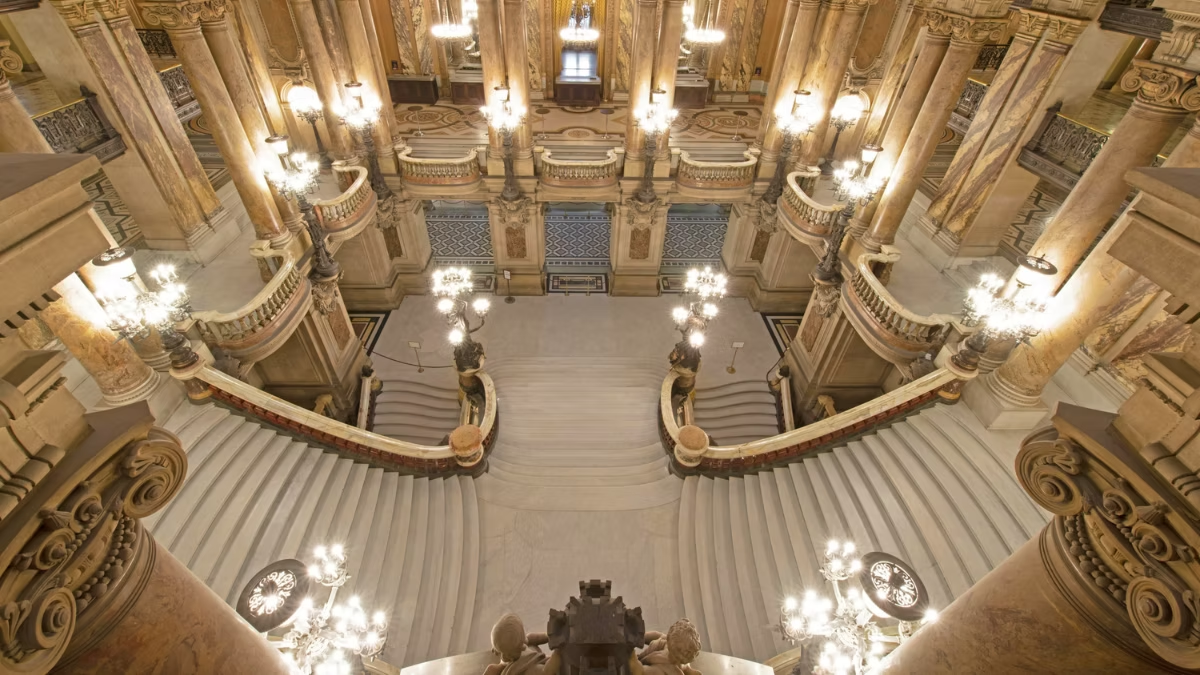
The Grand Staircase of Opera Garnier is a double-flight marble staircase rising through the building’s full entrance height, lined with bronze lamp-holders and lit by a glass ceiling above. It uses seven varieties of marble sourced from France, Italy, and Algeria. Designed as a social stage as much as a transit space, it is the building’s most photographed interior and the element that most immediately communicates Garnier’s ambition. Visit at 10:00 opening for the best light and fewest crowds.
There is a moment that happens to almost every visitor when they first see the Grand Staircase of Opera Garnier. You pass through the entrance vestibule, the space opens, and you stop. The staircase rises in front of you — twin flights of white marble sweeping upward to the landing above, flanked by bronze lamp-holders of extraordinary detail, the whole composition framed by multicoloured marble columns and lit from a glass ceiling that turns the space into something between a theatre and a greenhouse. It is one of those architectural experiences that photographs prepare you for inadequately.
Garnier designed it to do exactly this. The staircase is not primarily a means of getting from the ground floor to the auditorium. It is a performance space — a stage on which the arriving audience performed for each other before the curtain rose inside.
Architecture and Design
The Grand Staircase of Opera Garnier is 30 metres wide and uses seven varieties of marble — white Carrara marble for the steps, Algerian onyx for the balusters, red Languedoc marble for the columns, Sarrancolin marble for the walls, and others sourced from Pyrenean and Italian quarries. Garnier himself described the staircase as “the most important part of the building,” not for its function but for its social role. It was designed to be seen from all angles simultaneously, with gallery rails allowing the promenading audience to observe those arriving from above.
Charles Garnier was explicit about what he wanted the staircase to achieve. In his own writings, he described how the opera audience arrived not merely to watch a performance but to be part of one. The staircase was the first act. It needed to be wide enough for the fullest possible costumes, lit well enough to flatter the most elaborate dress, and designed so that those above could watch those below, and vice versa — creating an unbroken social circuit of display and observation.
The seven marble varieties are not decorative excess. Each was chosen for specific optical properties: the white Carrara steps reflect light upward; the deep red Languedoc columns anchor the composition against the white; the Algerian onyx balusters create a warm amber tone that flatters both complexions and candle-light. Garnier was working with a palette, not simply a building material.
The twin flights of the staircase — it splits at the first landing into two separate ascending paths — allow the maximum possible width of human traffic while maintaining visual coherence. At the landing itself, looking back down the staircase and then up to the ceiling above, the composition reveals its full depth.
The Seven Marbles
For visitors interested in materials, the staircase offers an extraordinary concentration of geological variety within a small space:
Steps: White Carrara marble (Tuscany, Italy) — the purest white available, chosen for its light-reflective qualities
Columns: Red Languedoc marble (Languedoc-Roussillon, southern France) — deep crimson with white veining
Balusters: Algerian onyx — warm amber, translucent when lit from behind
Wall facing: Sarrancolin marble (Hautes-Pyrénées, France) — multicoloured, with chaotic patterning that gives the walls their visual energy
Landing floor: A combination of Breche Violette and Campan Vert marbles — green and violet tones that ground the warm upper composition
Stair risers: Campan Rose — pale pink, providing visual continuity between the white treads and the coloured walls
Balcony rails: Grand Antique marble (Pyrenees) — black with white veining, providing the darkest tones in the composition
Running your hand along the balustrade as you ascend and noticing the temperature and texture changes between marble types is, oddly, one of the more tactile pleasures of an Opera Garnier visit.
The Social Function: A Stage Before the Stage
Understanding what the staircase was for transforms how you experience it. 19th-century Parisian opera attendance was not primarily about music. It was a social ritual — an occasion for display, connection, negotiation, and spectacle. The opera programme was a pretext; the staircase was where much of the real action happened.
The balconies on either side of the staircase were designed as viewing galleries. Women in full evening dress paused on the landing to be seen. Men assessed rivals and colleagues from the galleries above. Alliances were formed and ended. Reputations were made visible. Zola understood this perfectly — his novel Nana (1880) uses Opera Garnier’s staircase as a social stage with the same specificity that Leroux would later use its cellars.
This history makes the staircase more interesting rather than merely beautiful. You are standing in a space that was designed not for contemplation but for performance. The marble is gorgeous; the purpose is social theatre.
Photography Guide
The Grand Staircase is the most photographed interior at Opera Garnier and one of the most photographed interiors in Paris. Here are the three angles that consistently produce the best results:
From the base, centred, looking up: Stand at the foot of the staircase on the central axis, centred between the two ascending flights. Use a wide or standard focal length. The composition — twin flights rising symmetrically to the landing above, framed by columns and lamp-holders — is the defining Opera Garnier photograph.
From the upper landing, looking down: After ascending, turn back and look down the staircase. The spread of marble steps below, the arriving visitors, the entrance vestibule visible at the bottom, and the chandeliers of the Grand Foyer behind you create a different but equally compelling composition.
From the side galleries, oblique: The loggia galleries running alongside the staircase on each side allow oblique views that capture the staircase’s baroque profile — particularly effective at showing the relationship between the staircase, the columns, and the ceiling above.
Timing: The first hour after opening (10:00–11:00) gives you the staircase at its least crowded and with the best overhead light from the glass ceiling. By 11:30 in peak season, the space is significantly congested. For photography, an early visit makes a material difference. See our photography rules guide for equipment rules (no flash, no tripod).
Visitor Tips
Arrive at 10:00. The staircase is at its most impressive and least crowded in the first hour. The glass ceiling above produces soft, even light that fills the space without harsh shadows — particularly good for photography and for appreciating the marble colours as Garnier intended them.
Look at the lamp-holders. The bronze lamp-holders flanking the staircase are often overlooked by visitors focused on the marble. Each is a work of sculptural craft: female figures holding aloft globes, their detail extraordinary given that most visitors never look at them directly. Stop and examine one closely.
Look up from the landing. The upper landing offers the most complete view of the staircase’s full composition — the ceiling above, the twin flights below, the columns on all sides. It is the single best vantage point in the building for understanding what Garnier was attempting.
Read about the social history beforehand. The staircase is more interesting if you understand its function. Our visitor guide provides the essential background, and the audio guide covers it in depth — see our audio guide article for what the staircase narration covers.
Frequently Asked Questions
What type of marble is the Grand Staircase made of?
The Grand Staircase uses seven varieties of marble: white Carrara (Italy) for the steps, red Languedoc (France) for the columns, Algerian onyx for the balusters, Sarrancolin (Pyrenees) for the walls, Campan Vert and Breche Violette for the landing floor, and Grand Antique (Pyrenees) for the balcony rail details. Garnier sourced each variety for its specific optical properties within the overall composition.
Why is the Grand Staircase so wide?
The staircase was designed to accommodate the full width of 19th-century evening dress — the crinoline and bustle silhouettes of the Second Empire required enormous lateral space. More fundamentally, the staircase was designed as a social performance space: the width allowed the maximum possible traffic and the maximum possible visibility between those ascending and those watching from the galleries above.
Can you photograph the Grand Staircase?
Yes. Personal photography is fully permitted on the Grand Staircase. Flash and tripods are not allowed anywhere in the building. The best light for staircase photography is in the first hour after opening (10:00–11:00) when the glass ceiling above provides soft, even illumination. See our photography rules guide for full details.
Is the Grand Staircase accessible for wheelchair users?
The Grand Staircase itself is not wheelchair-accessible — it is a staircase. Wheelchair users and visitors with mobility needs access Opera Garnier’s main visitor levels via a lift on the accessible route. The accessible entrance provides access to the Grand Foyer, auditorium, and library-museum, though the staircase ascent itself is bypassed. See our accessibility guide for details.
How long should I spend at the Grand Staircase?
Most visitors spend 15–20 minutes at the staircase — ascending, looking from the landing, and taking photographs. Architecture enthusiasts examining the marble programme and lamp-holder detail may spend 30 minutes. In peak season with crowds, the experience is more hurried regardless of intention. An early arrival slot allows the most time.
