
History of Opera Garnier: From Napoleon III to Today
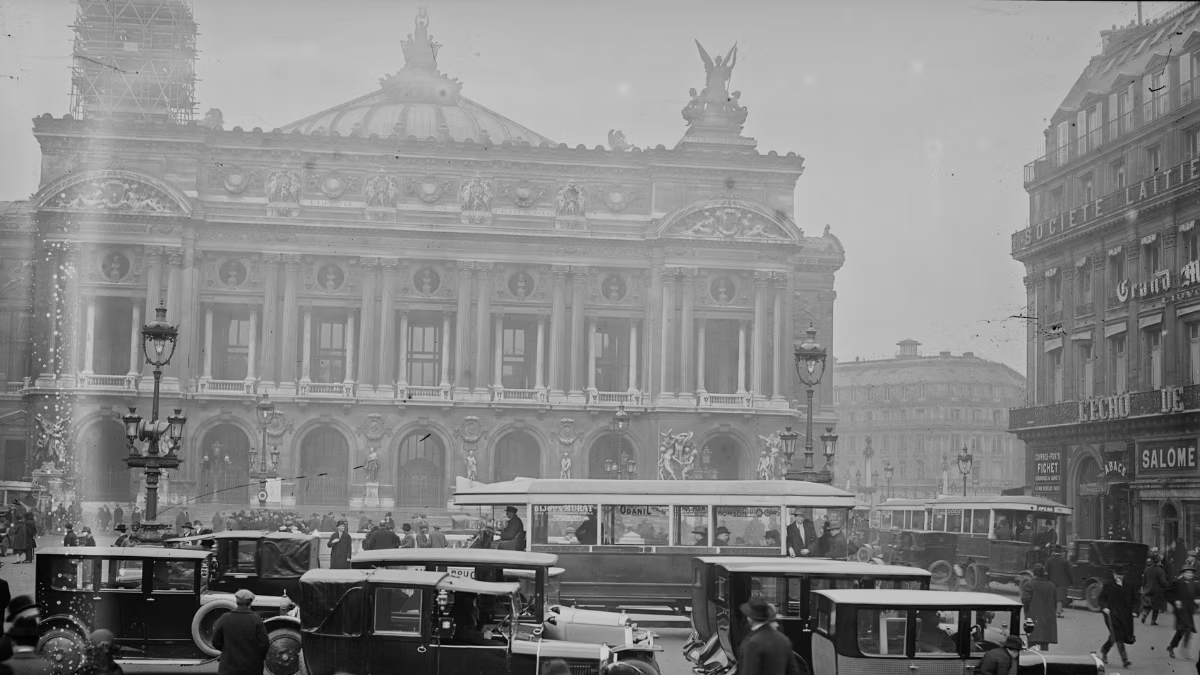
Opera Garnier was commissioned by Emperor Napoleon III in 1858 as part of Baron Haussmann’s transformation of Paris. Designed by Charles Garnier, who won an open competition against 170 competitors at age 35, construction began in 1861 and was repeatedly disrupted — by the discovery of groundwater (which created the underground lake), the Franco-Prussian War (1870–71), and the fall of the Second Empire. The building opened on 5 January 1875, five years after Napoleon III’s exile. It served as Paris’s principal opera house until 1989, when the Opéra Bastille opened. Today it functions primarily as a ballet venue and daytime cultural monument.
The history of Opera Garnier is, in miniature, the history of 19th-century France — the ambition of the Second Empire, the catastrophe of the Franco-Prussian War, the turbulence of the Commune, the slow confidence of the Third Republic, and the Belle Époque’s golden decades of cultural supremacy. The building opened in a city that was different from the one that had commissioned it. Understanding that gap between intention and completion is essential to understanding what the building is.
The Context: Haussmann’s Paris
Opera Garnier was conceived as part of Baron Georges-Eugène Haussmann’s transformation of Paris under Napoleon III (1853–1870). Haussmann’s grands travaux demolished medieval Paris and replaced it with the broad, straight boulevards, uniform Beaux-Arts apartment blocks, and monumental public buildings that define central Paris today. The new opera house was intended as both a practical improvement on the existing Salle Le Peletier (which was inadequate and fire-prone) and a cultural statement — a building that would announce Paris as the artistic capital of the civilised world.
By the late 1850s, Paris’s existing opera house — the Salle Le Peletier, dating from 1821 — was overcrowded, in poor structural condition, and positioned on a street that Haussmann’s redevelopment had made deeply inconvenient for the carriages of the aristocracy and haute bourgeoisie. An assassination attempt on Napoleon III as he arrived at the opera in January 1858 — a bomb thrown by Felice Orsini, which killed eight bystanders — added urgency to the need for a building with better security arrangements and a larger, more visible approach.
The decision to build a new opera house was taken almost immediately after the Orsini attack. The commission was political as much as cultural — Napoleon III wanted a building that would demonstrate the permanence and confidence of his regime, surrounded by the boulevards he was building, at a scale that would make every comparable building in Europe look modest.
The Competition: How Garnier Won
In December 1860, the government announced an open competition for the design of the new opera house. It attracted 171 entries, including submissions from the most established architects in France. The winner was Charles Garnier — 35 years old, with no major completed building to his name.
Garnier’s design prevailed for several reasons that his jury identified clearly. His understanding of the building’s programme was comprehensive — the circulation system that separated subscribers from walk-up ticket holders, servants from masters, performers from audience, delivery traffic from carriage arrivals, was more carefully considered than any other submission. His section drawing showed a complete understanding of the relationship between the auditorium, the stage machinery, and the public spaces. And his proposed facade — not the Palladian classicism most entrants offered, but a richly layered Baroque eclecticism that borrowed from multiple historical precedents — was, the jury agreed, the most assured and individual design in the competition.
Empress Eugénie reportedly asked Garnier at the announcement: “What style is this? It’s not Greek, it’s not Louis XVI — what is it?” Garnier replied: “It’s Napoleon III, Madame.” The answer has been quoted ever since as a definition of Beaux-Arts architecture at its most confident.
Construction: 1861–1875
The Groundwater Problem
Construction began in January 1861 on a site in the 9th arrondissement, on land that had previously been occupied by a series of smaller buildings and that sat on marshy subsoil above a high groundwater table. Within weeks of excavation, the site flooded. Pumping operations continued for eight months before engineers could progress.
The solution — retaining the groundwater in a concrete-lined reservoir rather than draining it permanently — created what is now the underground lake. The engineering decision was innovative and, as it turned out, correct: the building has shown no significant structural settling in 150 years. See our underground lake article for the full technical history.
The Interruptions
Construction was complicated throughout by political and military events. By 1870, the building was structurally complete to roof level but unfinished internally. Then the Franco-Prussian War began. Napoleon III was captured at the Battle of Sedan in September 1870 and the Second Empire collapsed. The Prussian army besieged Paris through the winter of 1870–71. During the Paris Commune of 1871 — the radical socialist government that held Paris for two months before being violently suppressed — the unfinished Opera Garnier was used as a military depot and prison.
By the time the Third Republic stabilised and building work could resume, Napoleon III was dead in English exile. The building he had commissioned to embody his regime would open in the political order that replaced it.
Garnier’s Personal Achievement
Throughout the 14-year construction period, Garnier maintained direct supervision over every detail of the building — the marble selection, the sculptural programme, the fresco commissions, the mechanical systems, the lighting. He spent much of his own savings on materials he considered inadequate in the official budget. He negotiated directly with quarry owners in Tuscany, Algeria, and the Pyrenees for specific marble varieties. He was simultaneously the building’s architect, its quality controller, and its chief advocate in a bureaucratic environment that was often hostile.
The building cost approximately 36 million gold francs — significantly over the original budget, by a margin that was largely the result of Garnier’s uncompromising standards rather than poor planning. The Franco-Prussian War interruption added to the final cost.
Opening Night: 5 January 1875
The building opened to a gala performance on 5 January 1875. The programme included extracts from several operas rather than a single complete work — a practical concession to a building whose technical equipment had not been fully tested. The French President, Patrice de Mac Mahon, attended in place of the emperor who had commissioned it. Napoleon III had died in exile at Chislehurst, Kent in 1873, having never seen his opera house completed.
Contemporary accounts of the opening describe the staircase and the Grand Foyer as overwhelming their audiences in exactly the way Garnier had intended. The auditorium was admired; the acoustic was considered — and continues to be considered — excellent for its size.
The Belle Époque and the Golden Age
The decades between 1875 and 1914 were the building’s great social period. Opera Garnier was the principal social venue of the French upper classes — attendance was as much about display as music, and the programming reflected the interests of an audience for whom the interval promenade was as important as the opera itself. The Grand Foyer hosted the encounters and negotiations of a class in its social prime.
The opera programme of this period included the premières of major works by Massenet, Saint-Saëns, and the French appropriations of Wagner that defined late 19th-century musical culture in Paris. The ballet programme maintained the Paris Opera Ballet’s position as the world’s leading classical ballet company.
It was in this period — specifically the late 1870s through the 1890s — that Gaston Leroux researched and eventually wrote his Phantom of the Opera. See our Phantom of the Opera article for the full account.
The 20th Century and the Arrival of Chagall
The building’s cultural status was largely stable through the first half of the 20th century, though the First World War, the Occupation, and the social changes of the interwar period changed both the programming and the audience. The building was not damaged during either World War.
The most dramatic post-opening change to the building’s interior was André Malraux’s 1964 Chagall ceiling commission — the decision to have Marc Chagall repaint the auditorium ceiling over Paul Baudry’s original 1874 work. The controversy surrounding the commission — which Malraux pushed through over considerable opposition — is covered in our auditorium and Chagall ceiling article.
The Opéra Bastille and the Present Day
The opening of the Opéra Bastille in 1989 fundamentally changed Opera Garnier’s role. The Bastille, designed as a fully functional modern opera house with superior technical capabilities, took over the main opera programming. Opera Garnier was repositioned as the home of the Paris Opera Ballet — its intimate scale and Belle Époque character making it the more atmospheric venue for classical and neo-classical ballet.
Today, Opera Garnier remains an active performance venue for the Paris Opera Ballet, while also functioning as a daytime cultural monument accessible to visitors. The dual identity — living performance space and architectural heritage site — is its defining characteristic and the source of both its appeal and its occasional complications for visitors (the auditorium closures, the unpredictable schedule).
Frequently Asked Questions
When was Opera Garnier built?
Construction of Opera Garnier began in January 1861 and the building opened on 5 January 1875 — a construction period of 14 years, interrupted by the Franco-Prussian War (1870–71) and the Paris Commune (1871).
Who commissioned Opera Garnier?
Napoleon III, Emperor of France from 1852 to 1870, commissioned the new opera house as part of Baron Haussmann’s transformation of Paris. The commission followed an assassination attempt on Napoleon III at the existing opera house in January 1858. Napoleon III never saw the building completed — he died in exile in 1873, two years before the opening.
Why was Opera Garnier built?
Opera Garnier replaced the aging and inadequate Salle Le Peletier as Paris’s principal opera house. The new building was intended as both a practical improvement and a statement of French cultural supremacy — a monument that would announce Paris as the artistic capital of the civilised world during the height of the Second Empire’s ambition.
When did Opera Garnier open?
Opera Garnier opened on 5 January 1875 with a gala performance attended by the French President. The opening programme consisted of extracts from several operas — a full production was considered too risky for a building whose technical systems had not yet been fully tested.
Is Opera Garnier still used for performances?
Yes. Opera Garnier remains an active performance venue, primarily for the Paris Opera Ballet. Most major opera productions have moved to the Opéra Bastille (opened 1989), but Opera Garnier continues to host a full ballet season and selected opera productions each year.
