
Opera Garnier Library & Museum (Bibliothèque-Musée): What’s Inside (2026)
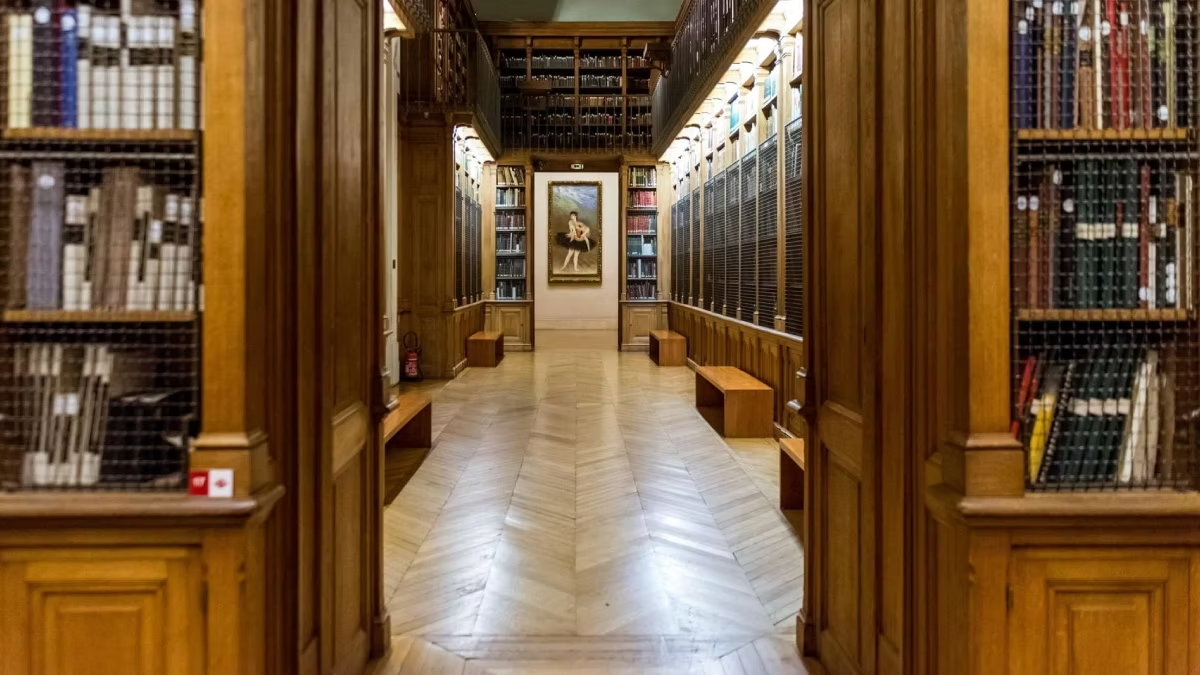
The Bibliothèque-Musée de l’Opéra (Opera Library and Museum) at Opera Garnier holds over 600,000 documents — scores, librettos, correspondence, photographs, set designs, and posters — plus a permanent display of historic costumes, stage set models, and archival material from the Paris Opera’s 350-year history. Entry is included with a standard Opera Garnier ticket. Most visitors spend 20–30 minutes here; ballet and opera enthusiasts can easily spend 45–60 minutes. It is worth more time than most visitors give it.
The Bibliothèque-Musée is the part of Opera Garnier that most visitors allocate too little time to. The Grand Staircase and Grand Foyer capture attention on arrival; the auditorium demands its share of wonder. By the time visitors reach the library-museum, they often have 20 minutes left before they need to leave, and they move through it as an afterthought.
This is a mistake. The Bibliothèque-Musée de l’Opéra holds the documentary and material record of one of the longest continuous performing arts institutions in the world — the Paris Opera, founded by Louis XIV in 1669 and operating without interruption to the present day. The collection is extraordinary by any standard. It is extraordinary in the context of an ordinary tourist visit.
What the Collection Contains
The Bibliothèque-Musée de l’Opéra holds over 600,000 items, making it one of the largest specialist performing arts archives in the world. The collection includes musical scores (including composer autographs), librettos, production correspondence, administrative records, photographs (over 100,000 images of productions and performers), set design drawings, costume designs, stage models, posters, programmes, and recordings. Items span from the founding of the Paris Opera in 1669 to current productions. The publicly accessible permanent display focuses on costumes, set models, and rotating archival selections.
Musical scores and manuscripts: The library holds autograph scores by composers including Lully (who directed the Paris Opera under Louis XIV), Rameau, Gluck, Meyerbeer, Gounod, Massenet, and Debussy — representing the full arc of French operatic composition. These are archival materials not generally on public display, held in the library’s closed stacks.
Photographs: Over 100,000 photographic images documenting Paris Opera productions and performers from the daguerreotype era (1840s) to the present. The visible portion of this collection in the permanent display includes remarkable production photographs from the late 19th and early 20th century — the era of the great Paris Opera Ballet’s first golden period.
Costumes: The permanent display includes historic costumes from the Paris Opera Ballet’s production history. These range from 19th-century ballet costumes — tutu construction, pointe shoes, stage jewellery — to 20th-century modernist productions. For visitors interested in fashion history and the evolution of theatrical costume, this is a genuinely compelling collection.
Stage set models: Scale models of historic Opera Garnier productions give a three-dimensional sense of the theatrical ambitions of different periods. The models are often displayed alongside the original set design drawings — comparing intention and execution is absorbing for anyone interested in theatrical production.
Posters and ephemera: Production posters from across the institution’s history include some of the most significant examples of French graphic design from the Art Nouveau and Art Deco periods — Mucha’s Paris Opera poster (1898) is one of the most iconic pieces of Art Nouveau graphic design in existence, and related material appears in the collection.
The Degas Connection
For visitors who plan to combine Opera Garnier with the Musée d’Orsay — see our Musée d’Orsay + Opera Garnier combo guide — the Bibliothèque-Musée provides important context for the Degas ballet paintings that are the d’Orsay’s most celebrated works.
Edgar Degas (1834–1917) painted the Paris Opera Ballet obsessively from the 1870s through the 1880s — the same period when Opera Garnier was being built and first operating. He attended rehearsals as a privileged visitor (his friendship with Opera management gave him backstage access not available to other painters), and his studies from life produced the paintings now housed at the d’Orsay.
The Bibliothèque-Musée holds period photographs and archival material from the same productions Degas painted — the same dancers in many cases, the same choreography, the same production designs. Seeing this material and then seeing the Degas paintings at the d’Orsay creates a documentary loop that gives each collection additional resonance.
Temporary Exhibitions
The Bibliothèque-Musée hosts temporary exhibitions that draw on the permanent collection and focus on specific aspects of the Paris Opera’s history or the performing arts more broadly. These exhibitions rotate throughout the year and can significantly change the character of a visit — a well-curated temporary exhibition on the history of French ballet costuming, or on a specific choreographer’s work, can be as absorbing as the permanent display.
Check the Paris Opera website for current temporary exhibition information before visiting. Some temporary exhibitions require a supplementary admission fee beyond the standard entry ticket.
How Long to Spend
- Most visitors (general interest): 20–30 minutes
- Ballet or opera enthusiasts: 45–60 minutes
- Researchers, fashion historians, theatre professionals: 60–90 minutes, and you’ll want to come back
The practical constraint is usually the end of your visiting time — if you’ve spent 90 minutes on the Grand Staircase, Foyer, and auditorium, you may have 20 minutes left. If the library-museum interests you, build that awareness into your visit planning and give yourself time to linger.
Visitor Tips
Visit the auditorium first, then come here. The library-museum works best as a contextual supplement to the building’s main spaces rather than an opener. Once you’ve seen the auditorium and its Chagall ceiling, the historical photographs of earlier productions in that same room carry more weight.
Look at the set models closely. The scale models of historic Opera Garnier productions are among the most arresting objects in the permanent collection. They convey the theatrical ambition of past productions in a way that photographs don’t — you can see the depth of stage, the height of flats, the intricacy of the painted backdrop systems.
Read the costume labels. The historic costumes often have labels noting the production, date, and in some cases the dancer or singer who wore them. These biographical details — the connection between a specific costume and a specific performer in a specific production — give the objects a particularity that makes them more than display pieces.
Frequently Asked Questions
Is the Opera Garnier library and museum worth visiting?
Yes, particularly for visitors with an interest in ballet history, opera performance history, theatrical costume, or French cultural history. Most visitors underallocate time here and leave wishing they’d spent longer. Entry is included in the standard Opera Garnier ticket.
What is in the Opera Garnier library and museum?
The permanent display includes historic costumes, stage set models, and rotating archival selections. The full collection holds over 600,000 items — scores, librettos, photographs, correspondence, posters, and other performing arts material spanning from the founding of the Paris Opera in 1669 to the present day.
Can I access the archives at the Opera Garnier library?
The library’s closed stacks (holding the scores, manuscripts, photographs, and archival material) are accessible to researchers by prior arrangement with the Bibliothèque nationale de France, which manages the collection. Contact the BnF (bibliothè[email protected]) for researcher access requests. Public visiting access covers the permanent and temporary display only.
How long is the Opera Garnier library and museum?
The library-museum occupies several rooms on the building’s upper visitor level. A comfortable visit through the permanent display takes 20–30 minutes for most visitors; 45–60 minutes for enthusiasts.
Does the Opera Garnier library hold Degas’s paintings?
The Bibliothèque-Musée does not hold Degas paintings — those are in the Musée d’Orsay’s collection. The library does hold period photographs, set models, and archival material from the same productions and period that Degas documented. For visitors interested in the Degas-Opera Garnier connection, a combined visit is worthwhile — see our Musée d’Orsay combo guide.
