
Opera Garnier Architecture Style: Beaux-Arts Eclecticism Explained
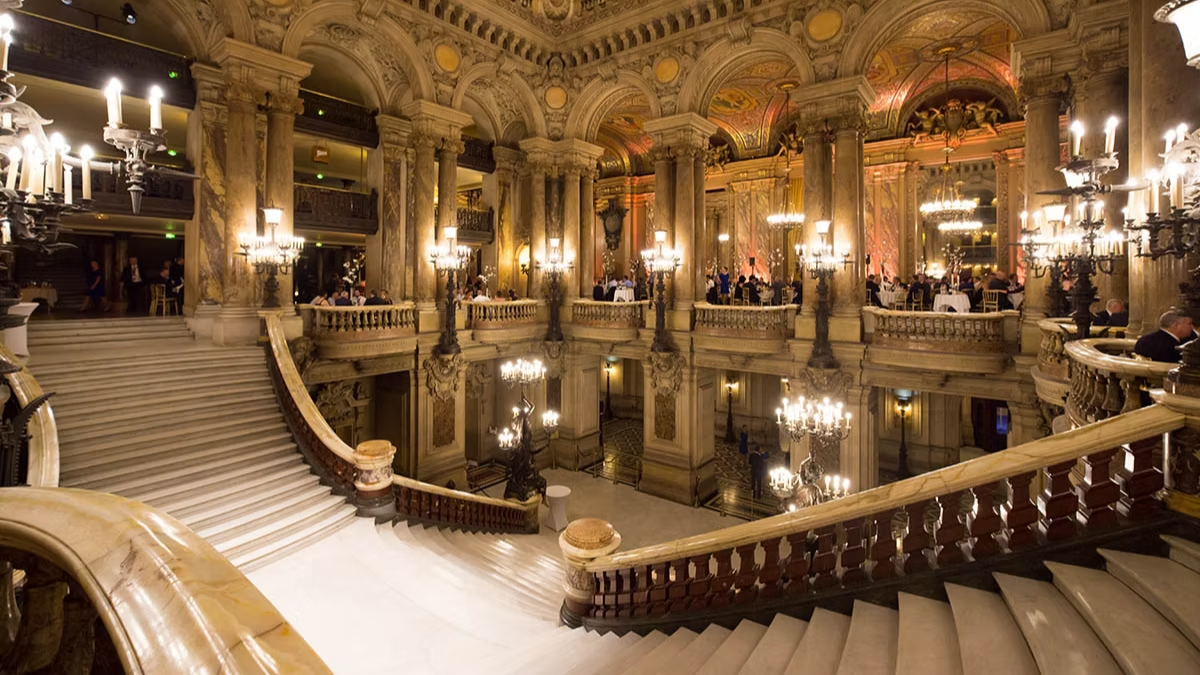
Opera Garnier is the defining example of Beaux-Arts eclecticism — an architectural style that draws freely on classical, Renaissance, and Baroque historical precedents, combining them with structural confidence to create buildings that feel simultaneously historically learned and entirely of their moment. The style was taught at the École des Beaux-Arts in Paris and became enormously influential in public architecture worldwide. Key elements at Opera Garnier include the rusticated base, the colossal column order, the sculptural programme, the polychrome marble interiors, and the complex silhouette of the roofline.
Visitors to Opera Garnier often feel that the building is almost too much — too many decorative elements, too many historical references, too much of everything. That sensation is not a design failure. It is the design. Understanding Beaux-Arts eclecticism — what it is, where it came from, why Garnier used it, and how it works — transforms the experience of the building from overwhelming to legible.
What Is Beaux-Arts Architecture?
Beaux-Arts architecture is a style of monumental public building developed at the École des Beaux-Arts in Paris from the mid-19th century. It is characterised by: the free combination of classical, Renaissance, and Baroque historical elements (eclecticism); rich exterior sculptural programmes; polychrome marble interiors; bilateral symmetry; a clear compositional hierarchy (base, column order, attic); and the principle that every design decision must serve a clear social or functional purpose. Opera Garnier (1875) is the style’s defining example. Beaux-Arts buildings using the same vocabulary include the Paris Grand Palais, the New York Public Library, Grand Central Terminal, and countless court houses, museums, and railway stations built between 1875 and 1940 worldwide.
The key word in Beaux-Arts is “eclectic.” Unlike the Gothic Revival, which insisted on historical purity (only Gothic elements, correctly deployed), or Neoclassicism, which drew exclusively on Greco-Roman precedents, Beaux-Arts architects selected elements from across the Western historical tradition based on their functional appropriateness and visual effect. A Beaux-Arts building might have a Roman rusticated base, an Italian Renaissance column order, a French Baroque sculptural programme, and a roofline derived from the French royal building tradition — all in the same design.
The justification for this eclecticism was philosophical: no single historical style was adequate for the full complexity of a modern public building. The architect’s role was to select, combine, and orchestrate historical elements with sufficient mastery to produce a coherent whole.
The Five Key Elements at Opera Garnier
1. The Rusticated Base
The lowest level of the building — the base through which the various entrances are cut — is finished in bold rustication: large blocks of stone with exaggerated joint lines that give the base a heavy, powerful character. This is a convention from Italian Renaissance architecture, specifically the Florentine palazzo tradition, where rustication signalled civic importance and structural permanence.
At Opera Garnier, the rusticated base also serves a practical function: it contains the building’s entry system, including the separate carriage entrance, pedestrian entrances, and the subscription access points. The heaviness of the base reads as stability — the foundation on which the building’s more elaborate upper floors rest.
2. The Colossal Column Order
Above the base, the building’s principal level is articulated by paired columns in the Corinthian order, running the full height of the main facade. These columns are “colossal” — spanning two floors in height — which gives the building its monumental scale relative to the street.
Garnier’s column order is freely derived from the Roman Corinthian tradition but adapted: the proportions are slightly compressed compared to strict classical standards, the capitals are elaborated with additional sculptural enrichment, and the entablature above them carries a frieze of lyres and theatrical masks that ties the decorative programme to the building’s function as a theatre.
3. The Sculptural Programme
Opera Garnier’s exterior carries one of the most ambitious sculptural programmes on any 19th-century public building. The principal groups are:
The facade groups: Four allegorical sculptural groups at the corners of the main facade represent the principal arts of the theatre. The most famous is La Danse by Jean-Baptiste Carpeaux — a group of dancing figures of such vitality and sensuality that it caused immediate scandal when unveiled in 1869 (it was vandalised by a moralist who threw ink on it). The original is now in the Musée d’Orsay; the building carries a copy.
The rooftop programme: The Apollo group at the apex, the flanking Poetry and Music figures, and the corner groups complete a vertical programme that reads, from the street, as a coherent argument for the centrality of the performing arts to civilised life.
The busts: Between the ground floor arches, portrait busts of composers punctuate the rusticated base — Mozart, Beethoven, and others, selected by Garnier as the authorities of the musical tradition the building celebrates.
4. Polychrome Marble Interiors
The interior’s use of multiple marble varieties — seven in the Grand Staircase alone — is the most immediately apparent characteristic of Beaux-Arts decoration at Opera Garnier. Colour in architecture was a central concern of the École des Beaux-Arts, informed by research into classical Greek buildings that showed them to have been brightly painted rather than uniformly white.
Garnier’s colour palette for the interior is warm: the white Carrara of the staircase steps, the deep red Languedoc columns, the amber Algerian onyx balusters, the gilded bronze lamp-holders and railings. The cumulative effect is of a space that responds well to candlelight and gaslight — which was, of course, the original illumination condition.
5. The Complex Silhouette
Beaux-Arts buildings are characterised by rich, complex rooflines rather than the simple triangular pediments of strict Neoclassicism. At Opera Garnier, the roofline is a sequence of domes, lanterns, and sculptural groups that vary in height and profile — creating a silhouette that reads differently from different viewing distances and angles.
The central dome above the auditorium, the stage house volume behind it, the front attic with its bust-topped columns, and the Apollo apex all contribute to a composition that announces the building as something exceptional from Paris rooftop level long before the facade details are legible.
How to Read the Facade
Standing on the south side of Place de l’Opéra and looking at the main facade, a methodical reading from bottom to top reveals the compositional logic:
Base level: Rusticated stone, arched openings for the building’s various entry points. Heavy, grounded, civic. The central carriage entrance is the widest arch; flanking subscription entrances are narrower. Social hierarchy encoded in width.
Principal level: Colossal paired columns, the building’s main programmatic spaces behind them (the Grand Foyer runs the full width at this level). The columns’ height and spacing create a regular rhythm that contains the compositional richness above.
Attic level: Above the cornice, a shorter attic storey with column-flanked busts and alternating arched and flat-headed openings. The building’s second register — less monumental than the principal level but richly detailed.
Roofline: The complex silhouette described above. At the apex, Apollo with his lyre — the programme’s symbolic summit.
Opera Garnier’s Influence Worldwide
The Beaux-Arts vocabulary that Garnier deployed at the Paris opera house became the global language of monumental public building for the half-century after 1875. Buildings directly influenced by Opera Garnier’s architectural approach include:
In France: The Grand Palais and Petit Palais (1900, Paris World’s Fair); the Gare de Lyon (1900); the Palais du Justice in Lyon.
In Europe: The Semperoper in Dresden, the Vienna State Opera (completed before but stylistically related), the Royal Opera House in Stockholm.
In the Americas: Grand Central Terminal in New York (1913), the New York Public Library (1911), the Library of Congress in Washington DC (1897), the São Paulo Municipal Theatre (1911), and hundreds of court houses, state capitols, and cultural buildings built in the Beaux-Arts tradition.
The style gradually fell from favour after the First World War, replaced by modernism’s rejection of historical eclecticism. But the buildings it produced — particularly Opera Garnier — have proved more enduring than its critics predicted.
Frequently Asked Questions
What architectural style is Opera Garnier?
Opera Garnier is the defining example of Beaux-Arts eclecticism — a style developed at the École des Beaux-Arts in Paris that combines classical, Renaissance, and Baroque historical elements with rich sculptural decoration and polychrome marble interiors. It was designed by Charles Garnier and completed in 1875.
What does Beaux-Arts mean in architecture?
“Beaux-Arts” refers to the French fine arts academy (École des Beaux-Arts) that developed and taught the style in the 19th century. As an architectural term, it describes monumental public buildings characterised by historical eclecticism, rich sculptural programmes, bilateral symmetry, polychrome marble interiors, and the principle that every design element should serve a clear social function.
Why does Opera Garnier have so much decoration?
The decoration is not excess — it is the building’s argument. Garnier understood the opera house as a social institution in which every surface was performing a role: announcing the building’s importance, signalling the hierarchy of its uses, creating the atmosphere in which social performance would take place. The decoration serves this social function. See our history of Opera Garnier for the broader context.
What is the Carpeaux sculpture at Opera Garnier?
La Danse by Jean-Baptiste Carpeaux is one of the four allegorical sculptural groups on Opera Garnier’s main facade, representing Dance. When unveiled in 1869 it caused immediate scandal — its sensuality was considered inappropriate for a public building. The original sculpture is now in the Musée d’Orsay; the building displays a copy made in 1964 in a more durable stone.
How did Opera Garnier influence world architecture?
The Beaux-Arts vocabulary Garnier established at the Paris opera house became the global language of monumental public building between 1875 and 1930. Grand Central Terminal, the New York Public Library, the Library of Congress, the São Paulo Municipal Theatre, and hundreds of court houses and cultural buildings worldwide directly reflect Opera Garnier’s architectural approach.
