
Opera Garnier with Kids: Family Visit Guide 2026
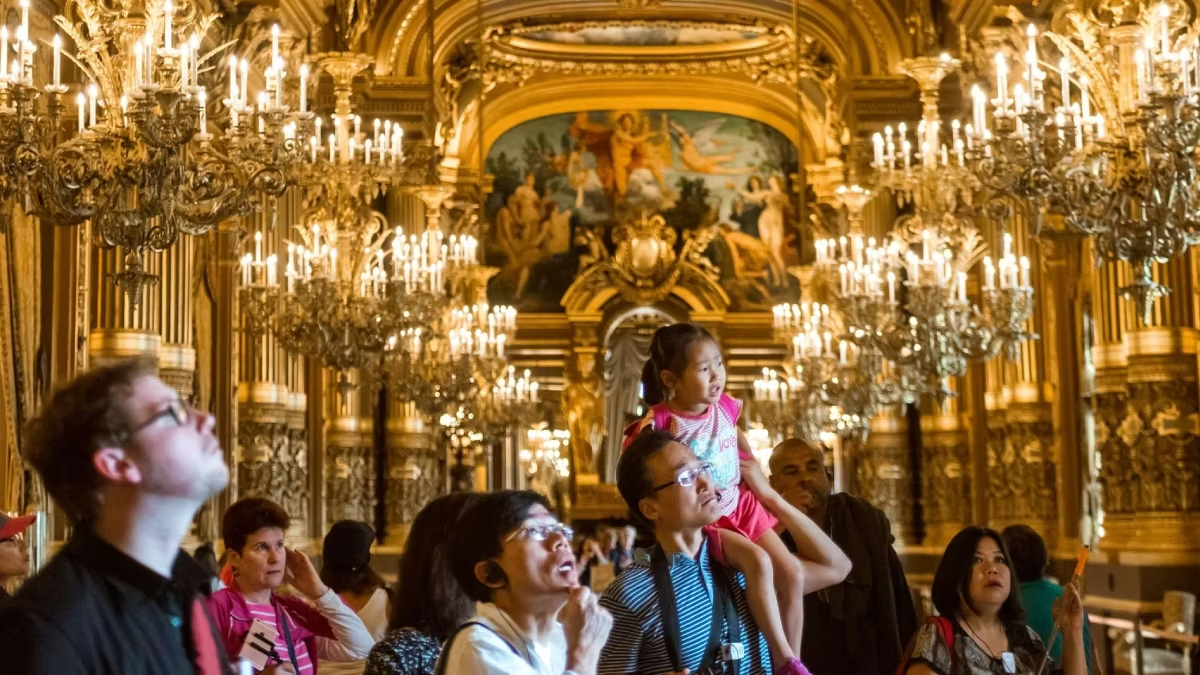
Opera Garnier is genuinely engaging for children aged 10 and older, especially those who know the Phantom of the Opera story. The Grand Staircase, the underground lake, and the sheer scale of the building tend to capture older children’s attention well. For under-10s, the visit is shorter and requires more active storytelling from adults to sustain interest. Under-10s enter free. There are no specific child-focused interactive exhibits during the standard daytime visit.
The question of whether Opera Garnier works as a family visit is really a question about age. I’ve seen 12-year-olds completely absorbed by the building — particularly the Phantom connection, the lake underneath, and the backstory of the architect — and I’ve seen 6-year-olds check out after the Grand Staircase photograph. The building is extraordinary, but it’s a 19th-century cultural monument, not a family attraction in the modern sense.
This guide gives you the honest picture: what children tend to engage with, how to prepare them, what the practicalities are, and when a family visit works best.
Age Guide: Who Gets the Most Out of the Visit
Under 6: The Grand Staircase is visually spectacular and children this age respond to the scale of it — there’s a genuine wow factor. Beyond that, however, the visit requires sitting through rooms full of paintings and gilded interiors that most young children find unengaging relatively quickly. A 30–40 minute walk through the staircase and foyer is often the realistic limit.
6–9 years: More sustainable, particularly if you arrive with some context to offer. The Phantom story is appropriate for this age range (it’s more gothic mystery than horror), and the revelation that there’s actually a lake under the building tends to land well. Children in this age range can typically do 45–60 minutes comfortably.
10–13 years: The sweet spot for the building. Children who have read or seen The Phantom of the Opera — the novel, the musical, or any film adaptation — will find Opera Garnier genuinely absorbing. The Grand Staircase, the auditorium, Box 5, the story of the lake — these connect directly to a narrative they know. 60–90 minutes is very manageable.
14+: Teenagers with any interest in architecture, theatre, film, or history tend to respond well. The building’s visual drama is undeniable, and the combination of history, mythology, and aesthetic spectacle gives them plenty to engage with.
Opera Garnier is most rewarding for children aged 10 and above, particularly those familiar with the Phantom of the Opera story. Under-10s enter free but may find the visit engaging for only 30–45 minutes without specific preparation. Children of all ages tend to respond to the Grand Staircase and the story of the underground lake. A 60-minute focused visit covers the essentials for a family group without overstretching younger children’s attention.
What Children Tend to Love at Opera Garnier
The Grand Staircase — the scale of it is immediately impressive for children of all ages. The double flights, the height of the ceiling, the sense of entering somewhere genuinely grand — it produces a reliable response.
The underground lake — you can’t visit it, but telling children there’s a real lake under their feet with a real history of mystery attached to it is reliably effective. The Phantom mythology gives this something concrete to latch onto.
The Chagall ceiling — for children who have any exposure to art or illustration, the dreamy, swirling colours of the Chagall ceiling tend to be more immediately engaging than the classical decorations elsewhere in the building. It’s colourful, different from everything else, and there’s a good story about why a modern artist painted the ceiling of a 19th-century opera house.
Box 5 — if children know the Phantom story, pointing out the box supposedly reserved for the Opera Ghost is a reliable highlight.
The size of everything — chandeliers, ceilings, staircases, mirrors. Children respond to things that are demonstrably bigger than they expected, and Opera Garnier delivers this consistently.
How to Prepare Children for the Visit
The single most effective preparation is telling the Phantom of the Opera story before you arrive — or watching part of the 2004 film, the Royal Albert Hall concert version, or even reading a child-appropriate version of the original Leroux novel. Once children know the story, the building becomes a location rather than just an interior, and that shift in frame makes the visit dramatically more engaging.
Key things to tell children before you go:
- There is a real lake under the building, exactly as described in the story
- The building has a Box 5 that was, according to the story, always reserved for the Phantom
- The huge chandelier you’ll see in the auditorium falls in the story — and a real chandelier famously fell during a performance in 1896
- The architect Charles Garnier won the competition for the building when he was only 35 and nobody had heard of him
These threads give children things to look for and ask about, which transforms a passive museum experience into an active one.
Family Ticket Prices
| Visitor Type | Price |
|---|---|
| Adult | ~€14 |
| Reduced (students, seniors) | ~€10 |
| Under 10 | Free |
Children under 10 enter free, which makes Opera Garnier unusually affordable for families with young children. For families with multiple adults and older children, the Paris Museum Pass covers entry for all pass holders and can represent good value if you’re visiting multiple Paris attractions.
Practical Tips for Visiting with Children
Keep it under 90 minutes. Even for engaged children, two hours in a historic building is often one hour too many. Plan for 60–75 minutes and leave while everyone is still happy rather than stretching until someone is struggling.
Arrive at 10:00. The building is quietest at opening, which means more space on the staircase (no squeezing past tour groups), calmer rooms, and a better environment for children who find crowds and noise overwhelming.
Bring snacks for after, not during. Eating is not permitted inside the building. Having a plan for a snack or small lunch immediately after the visit gives children something to look forward to, which helps sustain engagement in the final stretch.
Use the audio guide strategically. The standard audio guide is not specifically designed for children, but some of the stops — particularly on the Grand Staircase and in the auditorium — include context that children 10+ will find interesting. Don’t feel obliged to follow every stop; pick the ones that match your children’s interests.
Let children lead on the staircase. The Grand Staircase is one of the moments children genuinely enjoy — they want to go up and come down and go up again. Let them. The staircase is wide and the experience of ascending it is part of the visit.
Consider a guided tour for older children. A good guide who can tailor their narrative to a mixed audience — including children — makes the visit significantly richer. The private guided tour allows you to direct the experience specifically toward the Phantom mythology, the architecture, or whatever aspect your children are most interested in.
What’s Nearby for Families After the Visit
Galeries Lafayette — the famous department store is a 5-minute walk and has a spectacular atrium that children often enjoy. The rooftop terrace offers a free view over the Opéra quarter.
Jardin des Tuileries — about 20 minutes on foot, with open space, playgrounds, and open-air snack kiosks.
Palais Royal gardens — a calmer, more beautiful outdoor space 15 minutes south, with arcades, fountains, and room for children to run.
Frequently Asked Questions
What age is appropriate for Opera Garnier?
There is no minimum age, and under-10s enter free. In practice, the visit is most rewarding from around age 10, when children can engage with the Phantom mythology and appreciate the architectural grandeur. Younger children can still enjoy the Grand Staircase and the scale of the building for 30–45 minutes.
Is the Phantom of the Opera appropriate for children?
The original Leroux novel is gothic and slightly dark but not frightening in a modern horror sense. The musical is popular with children from around age 8–9. The 2004 film is rated PG. All versions are appropriate context for a visit to Opera Garnier for most children from around age 8 onwards.
Is there a children’s guided tour of Opera Garnier?
Not as a standard public offering. Some educational group visits are arranged specifically for school parties. For family visits, the private guided tour can be adapted to include child-friendly storytelling — ask about this when booking.
Can you take a pushchair/stroller into Opera Garnier?
Pushchairs are permitted in the accessible areas of the building. The Grand Staircase is not pushchair-accessible, but the lift route to the Grand Foyer level is available. For the full accessible route, contact the Paris Opera accessibility service in advance. See the accessibility guide for full details.
Is Opera Garnier better than Musée d’Orsay for children?
For children who know the Phantom story or have a strong interest in architecture, Opera Garnier is more engaging than the Orsay. For children interested in art, the Orsay’s Impressionist collection — with its vivid colours and recognisable subjects — tends to hold attention well. The Musée d’Orsay + Opera Garnier combo ticket lets you do both in a single day.
