
Opera Garnier Visitor Guide 2026: Everything You Need to Know
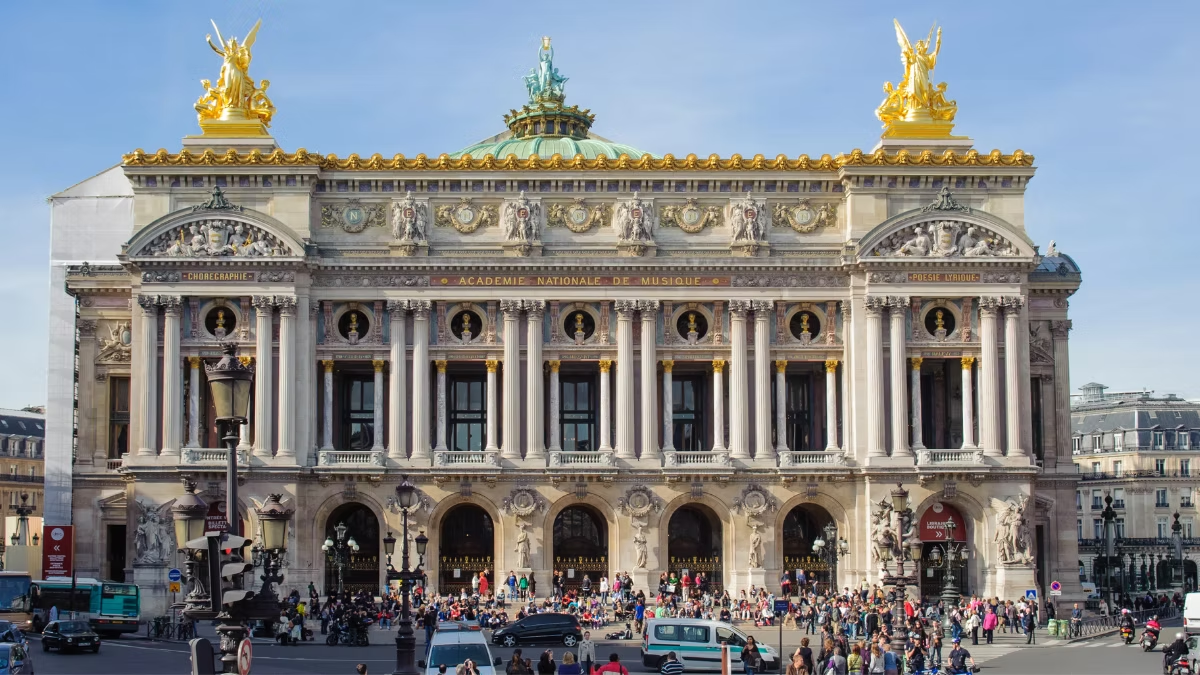
Opera Garnier (Palais Garnier) is a 19th-century Baroque opera house in central Paris, open daily for self-guided daytime visits from 10:00 to 16:30 (17:00 in summer). Entry tickets cost around €14 for adults. You can explore the grand staircase, the gilded auditorium with its famous Chagall ceiling, the underground lake, and the opera library. Booking in advance is strongly recommended during peak season.
Opera Garnier is one of those buildings that stops you in your tracks. Standing at the end of the Avenue de l’Opéra, this golden-fronted palace has dominated the 9th arrondissement since 1875 — and it looks every bit as extraordinary today as it did when Emperor Napoleon III commissioned it. Whether you know it as the home of the Phantom of the Opera, as one of Paris’s finest examples of Beaux-Arts architecture, or simply as that impossibly grand building you’ve seen in photographs, visiting it in person is a different experience altogether.
This guide covers everything you need to plan your visit: opening hours, ticket options, what’s inside, how to get there, and the things I’d tell a friend visiting for the first time.
What Is Opera Garnier?
Palais Garnier — named after its architect, Charles Garnier — was the principal opera house of Paris from its opening in 1875 until the Opéra Bastille took over large-scale productions in 1989. Today the building hosts ballet performances by the Paris Opera Ballet, smaller opera productions, and daytime visits for tourists and architecture enthusiasts.
It sits at the northern end of the 9th arrondissement, directly above the Opéra metro station, and covers over 11,000 square metres — making it one of the largest opera houses in the world by footprint. The auditorium alone seats 1,979 people.
Opera Garnier, officially called Palais Garnier, is a 1,979-seat opera house and national monument in Paris’s 9th arrondissement. Built between 1861 and 1875 to designs by Charles Garnier, it is a defining example of Second Empire Baroque architecture. It inspired Gaston Leroux’s 1910 novel The Phantom of the Opera. The building is open for public daytime visits daily except during rehearsals and performances, and is served directly by the Opéra metro station (lines 3, 7, and 8).
What to See Inside
The daytime visit covers the public areas of the building — not the backstage or working areas, which are accessible only on certain guided tours.
The Grand Staircase is the first thing you encounter and the moment most visitors reach for their camera. White marble, double-branching steps, and a cascade of light from the glass and iron ceiling — it is genuinely one of the most beautiful interior staircases in Europe. The staircase was designed as much for seeing and being seen as it was for moving between floors; at the height of the Second Empire, arriving at the opera was itself a performance.
The Grand Foyer runs along the front of the building and rivals the Hall of Mirrors at Versailles in its ambition. Gold leaf, painted ceilings, crystal chandeliers, and a long gallery of marble and mirrors — it was intended to give Paris an interior that could match anything the rest of Europe had to offer.
The Auditorium is what most people come to see. The famous Marc Chagall ceiling was added in 1964 at the invitation of André Malraux, and its dreamy, swirling panels — painted in twelve sections representing different operas and ballets — float above the original 19th-century horseshoe of red velvet and gold. Access to the auditorium during daytime visits depends on rehearsal schedules, so it is not always guaranteed.
The underground lake is real. A vast water reservoir sits beneath the building, used historically as a fire-fighting resource and later, famously, as the lair of Gaston Leroux’s Phantom. You cannot visit it, but you can read about it in the building’s museum, and the story alone is worth knowing before you arrive.
The Opera Library and Museum (Bibliothèque-Musée) holds over 600,000 documents: costumes, set models, paintings, performance archives, and manuscripts. It is often overlooked by visitors who head straight for the main rooms, which is a mistake — the collection is extraordinary.
For more detail on each of these spaces, see the What to See section.
Opening Hours
Opera Garnier is open daily from 10:00 to 16:30, with last entry at 15:30. In peak summer months (typically July and August) opening hours extend to 17:00, with last entry at 16:30. The building closes early — sometimes at 13:00 — on days when matinée performances are scheduled, so always check the official calendar before you go.
The opera house is closed on 1 January and 1 May. Unlike many Paris attractions, it is open on most public holidays.
For a full breakdown of seasonal hours and performance-day closures, see the dedicated opening hours guide.
Ticket Prices and Options
| Ticket Type | Price |
|---|---|
| Adult (self-guided daytime visit) | ~€14 |
| Reduced (students, over-65s) | ~€10 |
| Under 10 | Free |
| Audio guide | ~€6 additional |
Tickets can be bought at the door, but queues form quickly in high season. I always recommend booking online to guarantee entry, especially between April and September.
If you hold a Paris Museum Pass, Opera Garnier is included — and pass holders can also skip the ticket queue. See the full guide to Opera Garnier and the Paris Museum Pass for details on what’s covered and what isn’t.
For organised tours — guided group visits, private tours with an expert guide, or the premium private tour that includes a backstage ballet experience — see the Tickets & Tours section.
Getting There
The opera house is one of the easiest major Paris attractions to reach by public transport.
Metro: The Opéra station sits directly beneath the building, served by lines 3, 7, and 8. This is the simplest option from almost anywhere in central Paris.
RER: Auber station (RER A) is a two-minute walk and useful if you’re coming from CDG airport or Versailles.
On foot: Opera Garnier is a 20-minute walk from the Louvre, 15 minutes from Madeleine, and sits at the northern end of the Avenue de l’Opéra — a straightforward walk from central Paris.
Driving is not recommended. Central Paris parking is expensive and scarce, and the metro connection is too convenient to ignore. Full transport details — including routes from both Paris airports — are in the getting there guide.
How Long to Spend
A self-guided visit typically takes 1 to 1.5 hours to cover the main public areas. Add another 30–45 minutes if you plan to spend time in the museum and library. If you are joining a guided tour, allow 1.5 to 2 hours.
The building rewards slow exploration — the details in the mosaics, the painted ceilings, the ironwork — so don’t rush it. That said, if the auditorium is closed due to a morning rehearsal, the visit is shorter and you may want to factor that in.
For a detailed breakdown of how to budget your time, see how long to spend at Opera Garnier.
Best Time to Visit
The quietest period for daytime visits is November through February, excluding Christmas and New Year. Spring and early autumn (March–April and September–October) offer a good balance of reasonable crowds and pleasant weather. July and August are the busiest months — the building is full of tourists and queues for tickets can be long without pre-booking.
Mornings, especially from opening at 10:00, tend to be quieter than afternoons. Weekdays are noticeably less crowded than weekends.
Full seasonal guidance, including the impact of the Paris performance calendar on visit availability, is in the best time to visit article.
Practical Tips
Photography is allowed in most areas without flash. Tripods require prior permission. A few specific spots — including the auditorium — have restrictions on performance days. The Grand Staircase is the most photogenic spot in the building and the best light falls there in the morning.
What to wear: There is no dress code for daytime visits, but smart casual is appropriate. If you are attending an evening performance, the expectations are different — see the dress code guide for details.
Accessibility: The building is partially accessible. Lifts are available for most public areas, though some sections involve stairs that cannot be avoided. Wheelchair users should contact the opera house in advance. Full details in the accessibility guide.
With children: The Phantom story, the underground lake, and the sheer scale of the building make it surprisingly engaging for older children (10+). Younger children may find it less interesting. There are no specific child-focused activities during daytime visits. More on visiting with kids.
On-site facilities: There is a gift shop and cloakroom at the main entrance. A café is attached to the building. Toilets are available at no charge inside.
Is It Worth Visiting?
Yes — with the caveat that what you get depends on what you’re expecting. If you come for the architecture alone, Opera Garnier is one of the most extraordinary interiors in Europe, and the entry price is modest for what you see. If you’re hoping for a backstage theatre experience or access to the performance spaces without restriction, a guided tour or an evening performance will deliver far more.
The Phantom of the Opera connection is real and tangible — the lake is there, Box 5 is there, the atmosphere is unmistakably gothic beneath the gilded excess — and that layer of storytelling adds something genuine to the visit even if you’re not a theatre person.
For a detailed honest appraisal — including who it suits and who might find it underwhelming — see is Opera Garnier worth visiting?
Frequently Asked Questions
Do I need to book Opera Garnier tickets in advance?
You don’t have to, but I’d recommend it from April onwards. The ticket queue at the door can be 20–30 minutes long in peak season, and some time slots do sell out. Booking online takes two minutes and removes the uncertainty entirely.
Can I visit Opera Garnier without a guided tour?
Yes. The standard daytime visit is self-guided — you buy a ticket (in person or online), collect an optional audio guide from the desk, and explore at your own pace. Guided tours are available if you want an expert to walk you through the history and architecture.
Is Opera Garnier the same as Opéra Bastille?
No. They are two separate buildings. Opera Garnier (Palais Garnier) is the 19th-century building in the 9th arrondissement — the one with the iconic gold facade and the Phantom connection. Opéra Bastille is the modern opera house built in 1989 in the 12th arrondissement. Most large-scale opera productions now take place at the Bastille; Opera Garnier is used primarily for ballet and smaller opera productions.
Is the auditorium always open during daytime visits?
Not always. The auditorium may be closed on days with morning rehearsals or technical work. There is no reliable way to guarantee auditorium access in advance. Visiting early in the week (Monday–Wednesday) slightly reduces the chance of closure.
Is Opera Garnier included in the Paris Museum Pass?
Yes, a daytime self-guided visit is included with the Paris Museum Pass, and pass holders can use a separate entry queue to skip the ticket line.
